

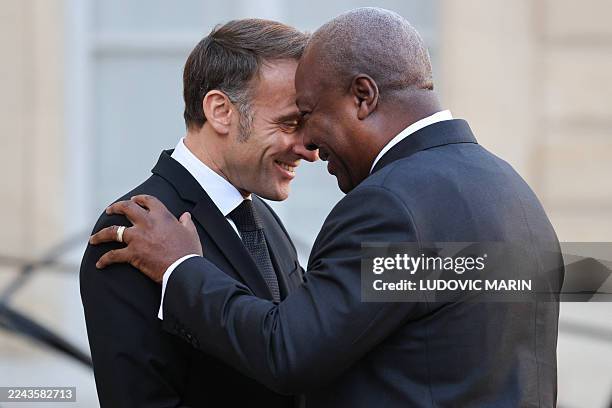

France has said the quiet part aloud: reparative justice is no longer a peripheral argument in its relationship with Africa. It is now part of the diplomatic conversation. President Emmanuel Macron’s reference to Ghana at the United Nations matters precisely because he did not speak only about development, aid or trade. He placed historical memory, cultural restitution and reparative justice within the same framework as the future of relations between the Global North and Global South. That shift is significant because it moves the conversation beyond the familiar language of partnership and development toward the harder question of what is owed when historical injustice has produced consequences that continue across generations.
Respect, however, cannot be reduced to eloquent speeches, conferences or carefully worded diplomatic declarations. If historical injustice is serious enough to be acknowledged, it must eventually produce serious consequences in policy, institutions and resources. Reparative justice cannot remain an attractive phrase in international diplomacy while the material and structural consequences of historical exploitation are treated as someone else’s responsibility. Recognition is an important beginning, but it cannot be mistaken for redress.
Macron said France is continuing work with Ghana and other willing partners to respond to demands for reparative justice. He also described the issue as one of respect. But respect without action risks becoming a polished substitute for accountability. The language is important. The substance will matter more. Ghana and other African countries will ultimately judge this new diplomatic language not by how elegantly it is expressed, but by whether it produces concrete commitments, meaningful institutional change and resources commensurate with the history being acknowledged.
Ghana Is Not Asking for a History Lesson
For Ghana, this conversation is not an abstract exercise in European self-examination. The country has pushed reparative justice onto the global agenda. In March 2026, the UN General Assembly adopted a resolution recognizing the transatlantic trafficking of enslaved Africans and racialized chattel enslavement as the “gravest crime against humanity,” with Ghana playing a leading role in advancing the resolution. President John Dramani Mahama has also publicly called for reparations for enslavement and colonization. That context changes the meaning of Macron’s statement. Ghana is not simply receiving a French invitation to discuss the past; it has been helping to define the terms of the international debate.
The central issue, therefore, is what “reparative justice” is supposed to mean. Is it financial compensation? Is it the return of cultural property? Is it investment in education, health and infrastructure? Is it debt relief or development finance? Is it an official acknowledgement of responsibility? Or must reparations encompass several of these elements? Ghana’s own international statements have argued that reparations should go beyond financial compensation and include substantive investments and formal recognition. These questions matter because without a clear understanding of what reparative justice requires, governments can acknowledge historical wrongs without addressing their continuing consequences.
Until such questions are addressed concretely, the phrase risks becoming diplomatic fog: morally impressive, politically convenient and operationally empty. Macron’s statement therefore matters not simply because France is willing to discuss reparations, but because the discussion now needs to move from recognition to substance, from acknowledging historical injustice to defining what meaningful repair would actually require.
History Must Produce Action
Macron’s strongest point was also his most demanding one: historical memory belongs in the architecture of international relations. France has pursued scientific work on historical knowledge and recognition and undertaken a legislative process enabling the restitution of cultural property. Macron explicitly connected those efforts with the reparative-justice discussion involving Ghana. This is important because restitution and reparations are related without being identical. Returning an artefact can correct a specific act of dispossession; it does not, by itself, resolve the wider economic and human consequences of slavery and colonialism. Likewise, development finance cannot automatically substitute for historical accountability. A road, school or loan may be valuable, but it does not become a reparation merely because it is described in the language of partnership.
That distinction should matter to both France and Ghana. France should be prepared to define what it is willing to recognize, return, finance or reform. Ghana, meanwhile, must articulate its objectives with equal precision. Reparations cannot remain a demand whose practical meaning changes depending on the circumstances. If the discussion is to produce meaningful results, both sides must be clear about what historical recognition entails and what concrete measures could give that recognition substance.
Nor should the discussion be reduced to a quarrel over whether present generations personally committed historical crimes. States are institutions that survive generations. The question is not individual guilt but whether states can acknowledge historical systems whose consequences still shape wealth, power, culture and international relationships. That is the more difficult question, and it is also the one that gives the reparative-justice debate its international significance.
The Test Is What Happens Next
This is where Macron’s statement becomes a test rather than a triumph. He announced no new reparations package for Ghana, no timetable and no specific mechanism in his UN remarks. That is the gap between recognition and action. International politics is full of language that sounds transformative until it encounters budgets, laws, competing interests and institutional resistance. Reparative justice will mean little if it becomes another phrase celebrated at summits and forgotten after the microphones are switched off.
Ghana should welcome the opening without surrendering its demands to symbolism. The next stage should be structured, transparent and measurable: sustained historical research, clear discussions on restitution, defined forms of material redress and an agreed process for reporting progress. France should not be expected merely to repeat its commitment. It should explain what that commitment means, what it will require and how progress will be measured. Words can open a diplomatic process, but only concrete commitments can give that process credibility.
If the Global North and Global South are to build a relationship based on equality, historical grievances cannot simply be placed in a museum of painful memories. They must be confronted as part of the political present. Reparative justice is not only about acknowledging what happened in the past; it is also about examining how the consequences of that history continue to shape economic relationships, political expectations and ideas of responsibility today. Any serious conversation about repair must therefore move beyond ceremony and address the substance of historical injustice.
Macron has put the words on the table. Ghana now has an opportunity to insist that the conversation move from language to substance. Reparative justice should not become an empty diplomatic slogan, repeated at international gatherings without measurable consequences. It should become a sustained process of recognition, restitution and durable repair over time. The real test will not be whether leaders continue to speak about historical injustice, but whether those words produce concrete commitments that can be examined, measured and followed through.