

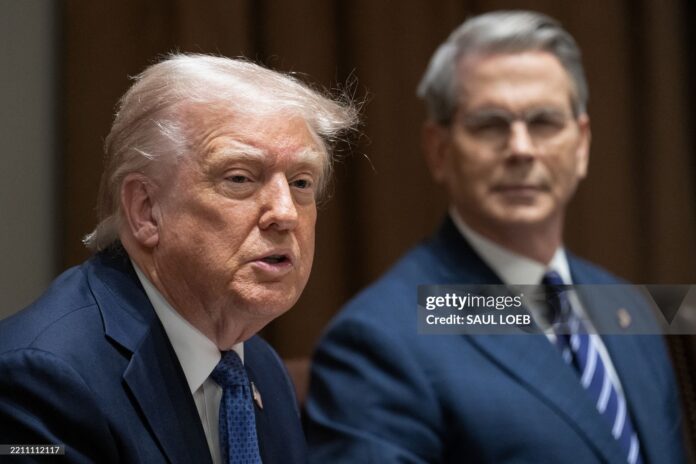

Iran’s oil lifeline is under extraordinary pressure. US Treasury Secretary Scott Bessent has now made a remarkably sweeping claim: Iran would have no oil shipments at sea during this week and, therefore, no associated oil revenues. His statement, made in an interview published on October 3, came as Washington intensified what he described as an unprecedented campaign to isolate Tehran economically. The significance lies not merely in the rhetoric. Oil is the financial bloodstream of the Iranian state. The US Energy Information Administration estimated that Iran’s oil companies generated about $53 billion in net oil-export revenue in 2023, up from roughly $37 billion in 2021. Petroleum and other liquids remain a major source of government income despite Iran’s relatively diversified economy.
For years, however, sanctions have failed to eliminate that trade. Iran developed an elaborate system of intermediaries, ship-to-ship transfers, front companies, discounted cargoes and vessels operating as part of a so-called shadow fleet. Chinese independent refineries became particularly important buyers. In 2025, China imported almost 1.4 million barrels per day of Iranian crude, according to the US-China Economic and Security Review Commission, accounting for roughly 12 percent of China’s total crude imports. That history explains why Bessent’s assertion matters. Washington is no longer relying exclusively on financial sanctions to make Iranian oil difficult to sell. It is attempting to prevent the physical movement of the commodity itself.
That is a different proposition. Sanctions raise the cost of doing business. A blockade or sustained interdiction can prevent the business from happening at all. Reuters reported in September that Iran had gone roughly seven weeks without meaningful crude exports through the Strait of Hormuz, after a US naval blockade disrupted the route through which Iranian crude had traditionally reached its principal remaining customer, China. The distinction is crucial: Washington is seeking to transform economic pressure from a financial problem for Tehran into a physical constraint on its ability to earn foreign currency.
The strategic objective is straightforward: reduce the barrels, reduce the dollars and reduce Tehran’s ability to finance the state, replenish military capabilities and sustain external networks. But the harder question is whether stopping ships is the same thing as stopping revenue. It is not necessarily. Oil markets are not simply pipelines from producer to consumer; they are networks of storage, intermediaries, alternative routes, opaque ownership structures and financial arrangements. Even when physical exports are disrupted, the effects on government revenue may depend on how much oil was already stored, how much can be moved through alternative channels, how quickly buyers adapt, and whether Iranian crude can continue reaching markets through less visible mechanisms.
The central issue, therefore, is not simply whether Washington can stop Iranian tankers from sailing, but whether it can sustain that pressure long enough to sever the mechanisms that have allowed Tehran to monetize its oil despite years of sanctions. Bessent’s claim, if borne out, would represent a significant escalation from the traditional sanctions model. Yet the ultimate measure of its effectiveness would not be the number of Iranian vessels at sea in a given week. It would be whether the disruption produces a sustained decline in Iran’s actual oil revenues and, consequently, constrains the government’s ability to finance its domestic and external priorities.
The Numbers Show Why the Pressure Is Serious
The scale of Iran’s dependence on maritime oil exports is substantial. China has accounted for the overwhelming majority of Iranian crude purchases, with the US-China Economic and Security Review Commission estimating that Chinese buyers took more than 90 percent of Iran’s crude exports in recent years. In 2025, those purchases were worth approximately $31.2 billion to Iran, even after substantial discounts. That gives Washington a clear pressure point and helps explain why the United States has progressively targeted the infrastructure surrounding Iranian oil. In April, the Treasury Department sanctioned the Chinese independent refinery Hengli Petrochemical and approximately 40 shipping companies and vessels linked to Iran’s shadow fleet. In May, Treasury imposed further measures against vessels involved in Iranian petroleum and petrochemical shipments, while warning that the campaign was intended to deprive Tehran of revenue.
Then came Operation Economic Outcast. Launched on August 24, the Treasury initiative was described by Washington as an unprecedented, whole-of-government economic campaign. It expanded pressure beyond oil traders to financial institutions, shipping, airlines, cryptocurrency networks, weapons procurement and other channels that Washington says sustain the Iranian state. The maritime results have been visible. Reuters reported that Iranian oil shipments to China had fallen sharply after Washington renewed its blockade of Iranian ships and ports. Kpler data put Chinese imports of Iranian crude at a provisional 534,000 barrels per day in August, compared with peaks of 1.58 million barrels per day earlier in 2026.
That is a dramatic reduction. But oil markets are rarely binary. A tanker stopped at sea is not necessarily a barrel permanently lost. Cargoes can remain in floating storage, ships can alter routes, oil can be transferred between vessels, buyers can use intermediaries and previously sold cargoes can remain in transit. Governments can also draw on inventories accumulated before restrictions tightened. The distinction between no new shipments and no oil revenue whatsoever therefore deserves scrutiny. A decline in observed maritime shipments may indicate significant pressure on Iran’s export system, but it does not by itself establish that the underlying oil has been permanently removed from the market or that the associated revenue has disappeared entirely.
Iran’s oil economy has repeatedly demonstrated an ability to adapt under pressure. The EIA notes that sanctions did not prevent Iran from increasing crude shipments, particularly to China, between 2020 and 2023. Iran also possesses substantial reserves and a theoretical crude-production capacity estimated by the EIA at about 3.8 million barrels per day if sanctions and other constraints were removed. These factors matter because the effectiveness of restrictions depends not only on whether individual tankers are stopped, but also on how successfully Iran can reroute exports, maintain access to buyers, draw on stored inventories and preserve production capacity under changing conditions.
Washington may therefore be choking the export pipeline, but it has not erased the oil beneath Iran. The immediate decline in shipments is significant, particularly given the importance of Chinese purchases to Iran’s oil revenues, but the longer-term effect depends on whether the restrictions can prevent Tehran from finding alternative routes, intermediaries and buyers. The distinction is important: disrupting the movement of oil is not the same as eliminating Iran’s capacity to produce, store or eventually sell it. The pressure may be substantial, but the durability of that pressure will depend on how effectively Iran adapts and how consistently Washington can sustain enforcement.
China Is the Test Washington Cannot Avoid
The decisive variable is China. For all the sophistication of the American sanctions architecture, Iran’s ability to earn oil revenue has historically depended on the willingness of Chinese independent refiners to accept Iranian barrels at discounted prices. Beijing has not embraced Washington’s unilateral sanctions regime. At the same time, China’s major state-owned refiners have generally avoided direct purchases of Iranian oil since US sanctions were restored in 2018, leaving smaller independent refineries to conduct much of the trade. This arrangement created a peculiar form of economic resilience: Iran could sell, China could buy, intermediaries could obscure the origin, and the financial system could be structured around currencies and channels less exposed to the dollar.
Operation Economic Outcast is designed to close those gaps. Bessent has made clear that Washington intends to use secondary sanctions to pressure institutions and companies outside the United States. Treasury has already warned foreign financial institutions and commercial actors that continued dealings with sanctioned Iranian networks could carry consequences. In August, Bessent said Washington expected additional secondary sanctions to follow on a regular basis. The strategy, therefore, is not simply to punish Iranian entities directly, but to raise the cost of doing business with them for the foreign companies and financial institutions that keep the oil trade functioning.
This creates a difficult calculation for Beijing. China imports enormous volumes of energy from the Middle East, but its economic relationship with Iran is only one part of a much larger regional network. The US-China Economic and Security Review Commission estimates that China’s two-way trade with Saudi Arabia and the United Arab Emirates was approximately $108 billion each in 2025, compared with about $41.2 billion with Iran when Iranian oil imports are included. That does not mean China will simply accept Washington’s demands. It means Beijing has multiple competing interests, including its broader commercial relationships across the Gulf and its longstanding opposition to the extraterritorial reach of US sanctions.
The bigger question is whether American pressure can force Chinese refiners to abandon Iranian crude without creating a wider confrontation over energy security and sanctions sovereignty. The answer will depend partly on enforcement and partly on prices. Iranian crude has often been sold at significant discounts, estimated at roughly $8 to $10 a barrel in some recent transactions. If those discounts become sufficiently large, the economic incentives for Chinese buyers remain powerful. If the legal, financial and logistical risks become greater than the savings, however, the trade becomes harder to sustain.
That is the battlefield on which the economic campaign will ultimately be judged, not by the number of sanctions announcements, but by whether barrels actually stop moving and whether buyers actually stop paying.
The Global Cost of Choking Iran
There is another problem for Washington: Iran does not operate in an economic vacuum. The Strait of Hormuz is one of the world’s most consequential energy chokepoints and before the war, roughly 20 percent of global oil and LNG supplies moved through the waterway. Even after major disruptions, regional exports began recovering in September. Kpler estimated Middle Eastern crude exports at 16.328 million barrels per day that month, while flows through Hormuz reached approximately 9.719 million barrels per day, still about 3.2 million barrels per day below the February pre-war level. Those numbers reveal the paradox. Washington can restrict Iran’s oil exports without necessarily eliminating oil flows from the Gulf. Saudi Arabia, the United Arab Emirates and other producers can continue shipping through alternative routes or under naval protection. Indeed, September’s rebound was driven largely by higher Saudi and Emirati exports.
But keeping those flows moving has a price. The United States has increasingly become part of the physical security architecture protecting commercial shipping. That means the economic campaign is no longer simply a Treasury exercise. It is connected to naval power, maritime surveillance, insurance, shipping risk and the broader security balance in the Gulf. Oil markets have already absorbed the consequences. By late September, Brent crude remained above $100 a barrel, roughly 40 percent above its pre-war level, while the United States had released 40 million barrels from its Strategic Petroleum Reserve to help stabilize supply. The result is a central strategic contradiction: the United States is trying to deprive Iran of oil revenue while simultaneously preventing an Iranian disruption of the wider Gulf oil system from producing a much larger global energy shock.
Bessent’s declaration that Iran will have no oil on the water is therefore best understood as a statement of strategic intent as much as a description of a particular week’s shipping position. If sustained, the policy could sharply reduce Tehran’s access to foreign currency and intensify pressure on an economy already weakened by sanctions, inflation, currency instability and years of underinvestment. But history counsels against assuming that economic isolation automatically produces political capitulation. Iran has survived decades of sanctions by adapting. China remains an enormous and sophisticated energy market, while oil can be stored, rerouted, disguised, discounted and traded through networks designed precisely to frustrate enforcement.
Washington has changed the equation by combining sanctions with maritime power. That is undoubtedly significant, but the real test begins after the headlines. Can the United States keep Iranian barrels off the water for months rather than days? Can it prevent China and other intermediaries from rebuilding alternative channels? Can it suppress Iranian revenues without driving global oil prices sharply higher? And can it sustain the naval and financial architecture required to enforce the pressure? Those questions matter more than the rhetoric surrounding Operation Economic Outcast.
For Tehran, the issue is the survival of an economic lifeline. For Washington, it is whether economic coercion can achieve what years of sanctions alone did not. The challenge is that the two objectives are connected to a much larger global system. The United States can target Iranian oil revenues, but it cannot isolate those actions completely from the broader Gulf energy market, the interests of other producers, the behaviour of China and the risks faced by commercial shipping. Every additional layer of enforcement therefore creates new economic and strategic consequences beyond Iran itself.
And for the world, the danger is that in trying to shut one oil pipeline of power, the United States may discover just how interconnected the global energy system really is. The effectiveness of the campaign will depend not only on Washington’s ability to impose pressure, but also on its ability to manage the consequences of that pressure: higher prices, shipping risks, alternative supply routes and the continuing capacity of Iran and its trading partners to adapt. The ultimate question is therefore not simply whether Washington can stop Iranian barrels from reaching the market, but whether it can do so without creating a larger disruption that ultimately undermines the economic objectives of the campaign itself.