

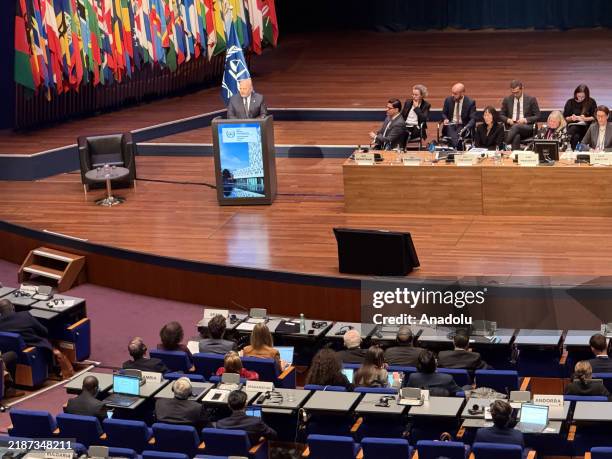

The Trump administration’s sweeping sanctions against the International Criminal Court threaten to derail high-profile war crimes trials and could force the release of detainees if the tribunal’s operations are crippled, legal experts warn.
Among those potentially affected is former Philippine president Rodrigo Duterte, who is awaiting proceedings in The Hague over allegations linking him to thousands of extrajudicial killings during his administration’s anti-drugs campaign from 2011 to 2019.
The United States has moved beyond sanctioning individual judges and officials to targeting the ICC itself, imposing restrictions designed to cut off American financial and commercial services to the court. The measures could disrupt essential operations, including banking, software provision and other services required to administer cases.
Ryan Goodman, a professor at New York University School of Law and former special counsel at the US Department of Defence, warned that the court could eventually become unable to conduct fair trials or appeals. If that happens, he said, continued detention could become legally untenable.
The implications extend beyond Duterte to other defendants awaiting trial or pursuing appeals in cases involving alleged atrocities in Libya, Sudan and the Central African Republic.
Duterte, 81, is accused of involvement in extrajudicial killings associated with his government’s anti-drugs campaign between 2011 and 2019. The allegations have placed the former leader at the centre of one of the ICC’s most closely watched proceedings.
Goodman said the prospect of detainees walking free because of financial restrictions would seriously damage international efforts to hold alleged perpetrators accountable. He also warned of the consequences for victims who have invested time and personal effort in the proceedings, expecting the court to deliver justice.
The potential disruption follows Washington’s announcement of sanctions prohibiting US entities from conducting transactions with the ICC. The administration says the action is necessary to defend American sovereignty and prevent the tribunal from exercising authority over US citizens.
Secretary of State Marco Rubio has accused the court of threatening American interests and urged allies that belong to the ICC to pressure it into addressing Washington’s objections.
The United States has previously sanctioned 17 ICC judges and officials. The latest measures, however, target the institution as a whole, creating the possibility of a wider operational crisis.
The sanctions include limited authorizations allowing services necessary to maintain facilities used to detain Duterte and other suspects. But Goodman cautioned that such exemptions may not resolve the underlying problem if the court loses the financial and technical capacity to conduct legally sound proceedings.
A six-month grace period before some restrictions take effect is intended to give ICC member states an opportunity to negotiate with Washington. The United States has said the arrangement allows room for a possible resolution, although the administration has not made withdrawal of the court’s arrest warrants against Israeli officials an explicit condition for lifting the sanctions.
The measures have triggered a strong international backlash. United Nations Secretary-General Antonio Guterres warned that the decision would weaken collective efforts to achieve international criminal justice.
The United Kingdom, Canada, Denmark, Germany, France, Italy, Japan and the Netherlands have also reaffirmed their support for the court, rejecting the sanctions and commending its staff for pursuing cases involving serious international crimes.
The Netherlands, which hosts the ICC in The Hague, has warned that the restrictions could severely undermine its ability to function.
The court itself has condemned the measures as an attack on the rule of law, saying it would not abandon its work in the face of pressure.
Established in 2002, the ICC prosecutes genocide, war crimes and crimes against humanity and has 125 member states. The United States is not a member, alongside other major powers including Russia, China, India and Israel.
Washington’s opposition has centred on the court’s former investigation into alleged crimes by US soldiers in Afghanistan, which has since been closed, and its arrest warrants for Israeli officials, including Prime Minister Benjamin Netanyahu.
Netanyahu has welcomed the sanctions, arguing that the tribunal threatens national sovereignty and law-abiding democracies.
The confrontation also comes as former ICC judge Navi Pillay receives the 2026 Nobel Peace Prize for efforts to promote peace and international law, sharpening the focus on the role of international institutions in delivering accountability.
For victims and their families, the consequences could be profound. If financial restrictions prevent trials from proceeding, people who have testified or otherwise participated in ICC cases may see years of efforts to secure justice jeopardized.
The emerging crisis raises a fundamental question about the resilience of international justice: whether a court tasked with prosecuting the gravest crimes can continue to function when a major world power moves to restrict the services and financial infrastructure on which its work depends.