

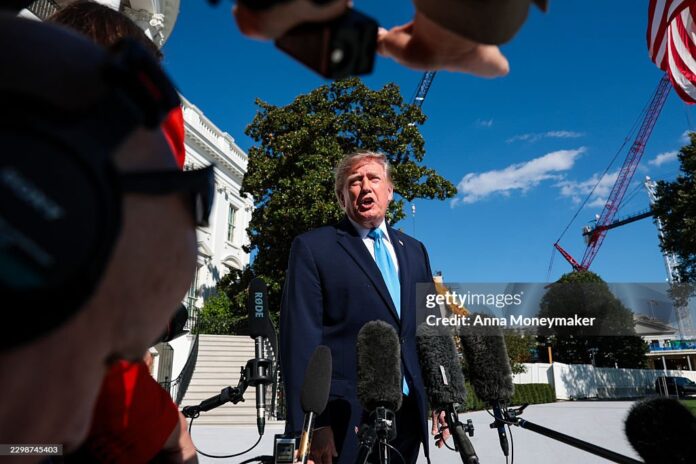

The investigation is the message. When the United States Department of Justice opens an antitrust inquiry into five television networks after they jointly suspend coverage of President Donald Trump, the consequences extend far beyond broadcasting. The question is no longer simply whether journalists can cover the president without political interference. It is whether the government can use competition law to discourage media organizations from collectively resisting restrictions on access.
Announced on October 10, 2026, the investigation targets ABC, CBS, CNN, Fox News and NBC. The networks temporarily halted White House television pool coverage after the administration revoked credentials for journalists from CNN, MS NOW and Politico in September. The Justice Department is examining whether the broadcasters’ coordinated response violated antitrust law, particularly the Sherman Act. Department spokesperson Emily Covington said group boycotts among commercial competitors can violate the law. An investigation, however, is not a finding of guilt. That distinction matters when news organizations confront the government they cover.
The networks’ action followed the administration’s exclusion of journalists whose reporting Trump disliked. A federal judge subsequently ordered their access restored, finding the restrictions likely unconstitutional. The credentials were reinstated, and television pool coverage resumed. Yet the Justice Department’s investigation has opened another front in a confrontation testing the boundaries between presidential authority, commercial competition and constitutional liberty.
The Antitrust Argument and Its Limits
The government’s legal theory cannot simply be dismissed. The Sherman Act, enacted in 1890, prohibits agreements that unreasonably restrain trade. Section 1 has been used against collusion among competitors, including certain collective refusals to deal. Media companies are not automatically exempt from competition law because their products are journalism.
But the legal question is more complicated than “group boycott” suggests. Investigators must establish an agreement and show that it constitutes an unlawful restraint of trade. The networks did not fix advertising prices or divide audiences; they responded to the exclusion of particular journalists from a shared presidential press pool.
The inquiry must demonstrate more than coordinated behaviour. It must establish a legally sufficient antitrust violation. Otherwise, an expansive interpretation of competition law could make media organizations reluctant to coordinate even legitimate responses to government interference. The danger is not that antitrust enforcement should stop at the newsroom door. It is that enforcement must remain anchored in evidence, statutory requirements and consistent legal principles rather than political grievance.
Access, Retaliation and the First Amendment
The press pool exists because covering a presidency requires logistical coordination. Space aboard aircraft, access to restricted locations and the practical limits of presidential movements make it impossible for every newsroom to operate independently at every event. Pool reporters gather material and share it, allowing other outlets to inform audiences without duplicating every cost or security arrangement.
When the White House excludes selected organizations, the consequences reach beyond those reporters. They affect the flow of information to millions of Americans. The September restrictions prompted CNN, MS NOW and Politico to challenge the administration in court, arguing that the exclusions violated constitutional protections and punished unfavourable reporting. Judicial intervention underscored a central principle: government officials cannot treat access to public institutions as a reward reserved for compliant journalism.
The First Amendment does not give every reporter unrestricted entry to every secure presidential event. Administrations may impose legitimate, viewpoint-neutral rules involving security, space and operational requirements. But access decisions become constitutionally troubling when officials use them to penalize viewpoints or reporting. The government’s stated reasons, the consistency of its rules and evidence of retaliation all matter.
The Justice Department’s intervention creates an institutional tension. The department is responsible for enforcing federal law, not protecting presidential pride. Its antitrust division must investigate evidence impartially, even when political allies or opponents are involved. Yet when an administration restricts journalists and subsequently investigates broadcasters that collectively protest, the sequence invites scrutiny of the department’s independence.
Smaller outlets, with fewer lawyers and less financial resilience than national broadcasters, could be particularly vulnerable. News executives facing legal expenses, litigation and uncertainty may conclude that challenging the White House is commercially dangerous. The result could be self-censorship without a formal prohibition on publication.
The Stakes for American Democracy
Trump’s conflict with the press predates this investigation. His denunciations of unfavourable reporting as “fake news” have helped turn disputes over accuracy and editorial judgement into political battles about institutional legitimacy. His administration’s latest actions sharpen that conflict by placing regulatory and prosecutorial pressure alongside restrictions on access. The combined effect deserves attention, although each action must be assessed on its own evidence and legal merits.
Fox News’s inclusion is revealing. The investigation covers broadcasters with different audiences, editorial cultures and relationships with Trump. Their common participation in the pool does not establish that they share a political agenda. It does demonstrate that the dispute concerns the operating conditions of presidential journalism, not merely the relationship between Trump and outlets routinely portrayed as hostile to him.
The implications reach beyond American borders. The United States has presented press freedom, constitutional checks and independent institutions as essential to democratic governance. When its government investigates broadcasters after collective resistance to restrictions on reporting, authoritarian governments elsewhere may cite the episode to justify their treatment of independent media. American credibility depends not on claiming democratic perfection, but on demonstrating that institutions can correct abuses and apply the law without political favour.
The networks, meanwhile, should not receive automatic immunity from scrutiny. Their conduct must be transparent, and their legal arguments must withstand examination. Collective action can create competition concerns in other circumstances. But accountability must run both ways: corporations must obey the law, and public officials must not manipulate enforcement to punish unwelcome scrutiny.
Ultimately, the decisive test is whether investigators can produce evidence of an actual antitrust violation independent of the administration’s anger at the press. If they can, the case should proceed through ordinary legal channels. If they cannot, the investigation should end without political pressure substituting for proof.
A democracy is not measured by whether its president enjoys favourable coverage. It is measured by whether journalists can investigate power, challenge official narratives and report uncomfortable facts without fearing retaliation through the state. The Justice Department’s inquiry may yet establish a legitimate competition concern. But unless its legal basis is compelling and its handling demonstrably independent, it risks turning antitrust enforcement into a warning to every newsroom: resist the president collectively and the government may come after you. That is a far more consequential question than whether five networks briefly stopped filming.