

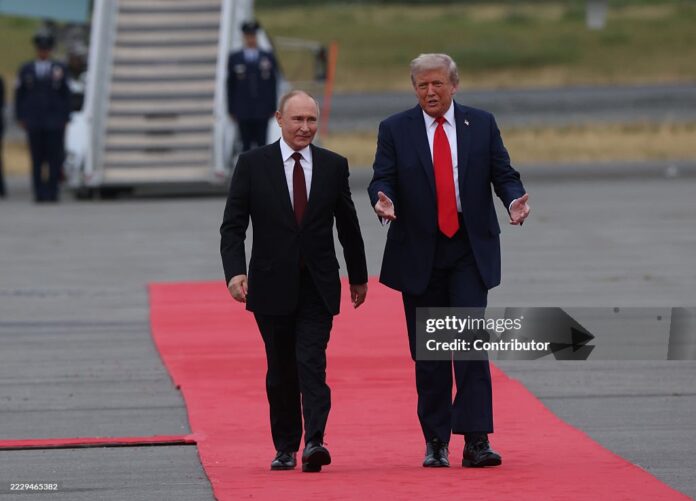

US President Donald Trump is facing mounting bipartisan criticism over plans to import millions of tonnes of diesel from Russia, a move opponents say could provide financial relief to Moscow while its war against Ukraine continues.
Trump announced on Friday that Russian President Vladimir Putin had agreed to release an initial 300,000 tonnes of diesel for the US and international markets, with additional shipments planned in the coming months. The arrangement has drawn scrutiny because it follows Trump’s approval of legislation authorizing new sanctions and tariffs against countries importing Russian oil and gas.
Under the proposed schedule, Russia would supply another 500,000 tonnes in November, followed by one million tonnes and a further three million tonnes within a relatively short period. The timing of the final deliveries would depend partly on the condition of Russian refineries, several of which have been targeted by Ukrainian attacks during the ongoing conflict.
The deal has triggered objections from lawmakers across party lines, with seven US senators arguing that easing restrictions on Russian energy exports would undermine American policy towards Moscow.
In a joint statement on Sunday, four Republicans and three Democrats urged Trump to abandon the arrangement, warning that continued purchases of Russian energy would help sustain Putin’s war effort.
The lawmakers said the United States should not provide Moscow with additional revenue while Russian forces continued to kill Ukrainian civilians. They also cited the congressional prohibition on Russian energy imports introduced in 2022 to prevent American money from supporting Russia’s invasion of Ukraine.
The statement was signed by Republican senators Susan Collins, Lisa Murkowski, Thom Tillis and John Curtis, alongside Democrats Jeanne Shaheen, Richard Blumenthal and Ron Wyden.
Ukrainian President Volodymyr Zelensky has also condemned the arrangement, arguing that the additional revenue would benefit Putin and undermine efforts to bring the war to an end.
The US Treasury is understood to be suspending sanctions on Russian diesel exports until April 7 under the agreement. Other Russian assets, including funds held in American banks, remain frozen.
Trump has defended the move as necessary to bring down fuel costs, which have surged since the US-Israeli war against Iran began at the end of February and disrupted global crude oil supplies.
In a post on Truth Social, he emphasized that reducing costs for American consumers, particularly farmers, ranchers and truck drivers, remained his overriding priority.
Russia’s Deputy Prime Minister Alexander Novak confirmed the proposed shipment volumes to the state-owned TASS news agency. He also indicated that Russian diesel exports under the arrangement could eventually reach three million tonnes a month.
Treasury Secretary Scott Bessent has defended the administration’s approach, telling Fox News that the agreement could be implemented through existing legal mechanisms available to the US government. He rejected arguments from congressional critics that the arrangement would violate American law.
Not all Republicans oppose the move. Representative Thomas Massie, who has frequently clashed with Trump on policy matters, has called for sanctions on all petroleum products to be lifted.
The dispute comes as rising energy costs threaten to become a significant political liability for Trump’s Republican Party ahead of next month’s midterm elections, which will determine whether the party retains control of Congress.
Opinion polls indicate that a majority of Americans disapprove of Trump’s handling of the economy and the conflict involving Iran, increasing pressure on his administration to find ways to ease household and business costs.
The impact has been particularly severe in agricultural states, where diesel is essential for operating farm machinery and transporting produce. Higher fuel costs have added to the financial pressures facing farmers and other businesses dependent on energy-intensive transport.
The average US diesel price currently stands at $6.28 per gallon, according to the American Automobile Association, below the record $6.53 reached at the end of September.
However, analysts have questioned whether Russia can deliver the promised volumes and whether the shipments would be large enough to produce meaningful savings for American consumers.
The United States consumes approximately 3.6 million barrels of diesel daily. The initial Russian shipment of 300,000 tonnes would therefore represent only a fraction of the country’s overall demand, although the precise contribution would depend on the timing and rate of delivery.
Opposition to the arrangement has also emerged among US allies. Canadian Prime Minister Mark Carney and UK Defence Secretary Wes Streeting have criticized the prospect of easing pressure on Moscow, arguing that Washington and other supporters of Ukraine should instead intensify efforts to force Russia to end the war.
Separately, Trump announced on Sunday that Russia and Ukraine had agreed to an energy ceasefire, without providing details about its terms or implementation.
Zelensky welcomed the announcement, but Moscow had not publicly responded at the time of reporting.