

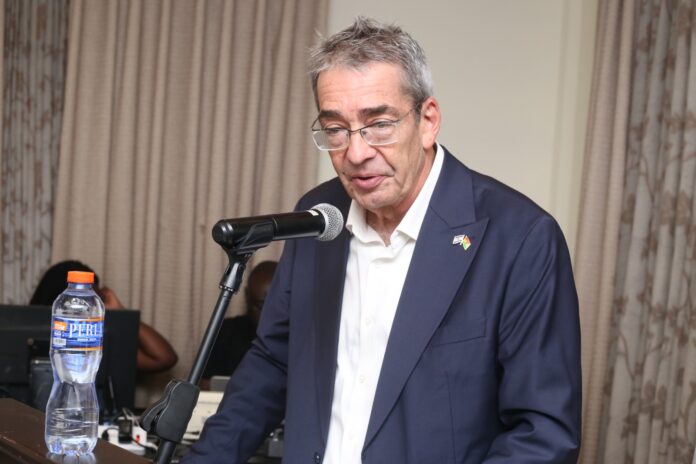

Israel has urged African countries to draw lessons from the October 7, 2023, Hamas-led attack, warning that the threat posed by armed extremist groups transcends borders and presents a shared security challenge for the Middle East and Africa.
Israeli Ambassador to Ghana, Liberia and Sierra Leone Roey Gilad said the tactics and threats confronting Israel were not fundamentally different from those facing countries battling militant groups in Africa’s Sahel region.
“Terror is terror. Whether in Lebanon, in Gaza or in the Sahel, it is the same challenge”, he said.
Mr. Gilad was addressing the annual October 7 massacre memorial event organized under the auspices of the Embassy of Israel in Ghana, which featured a special symposium on terrorism in the Middle East and Africa.
He said the event was designed to examine how the 2023 attack on Israel could inform responses to terrorism elsewhere, particularly in African countries confronting armed non-state actors.
The ambassador described a world in which such groups challenge established states as a growing international security concern, arguing that the lessons of October 7 extended beyond Israel’s borders.
The attack, which killed about 1,200 Israelis, injured thousands and resulted in the abduction of 251 people into Gaza, exposed what Mr. Gilad described as a profound challenge to Israel’s belief that its statehood guaranteed the security of the Jewish people.
He said the assault had transformed Israeli society, leaving the country more suspicious and anxious but also more determined to defend itself.
Mr. Gilad argued that the international community needed to recognize the threat posed by groups that launch attacks against stronger states and the potentially devastating consequences that follow.
Turning to the war in Gaza, he acknowledged its heavy human toll but blamed Hamas for the tragedy, maintaining that the group’s October 7 assault had set the subsequent conflict in motion.
He said Israel’s war against Hamas would continue until the group was disarmed and dismantled.
The ambassador also emphasized developments along Israel’s northern border, where he said Israel was engaged in political dialogue with Lebanon’s government to address Hezbollah’s presence and strengthen the role of the Lebanese army.
He welcomed changes in Syria’s regional posture, describing its new leadership as less hostile to Israel and no longer maintaining its traditional relationship with Iran.
Mr. Gilad further thanked Ghana for its contribution to security along the Israeli-Lebanese border through its participation in the United Nations Interim Force in Lebanon (UNIFIL).
He noted that Ghanaian soldiers serving with the mission had firsthand experience of the Blue Line, the boundary separating Israel and Lebanon.
The symposium formed part of the embassy’s broader effort to use the October 7 commemoration as a platform for examining the implications of terrorism for international peace and security.
Mr. Gilad said the challenge confronting governments was increasingly defined by armed groups operating outside conventional state structures and seeking to undermine the security of established states.
For African countries facing militant violence, he suggested, the experience of Israel offered lessons for understanding the threat, even as each region faced its own security realities.