

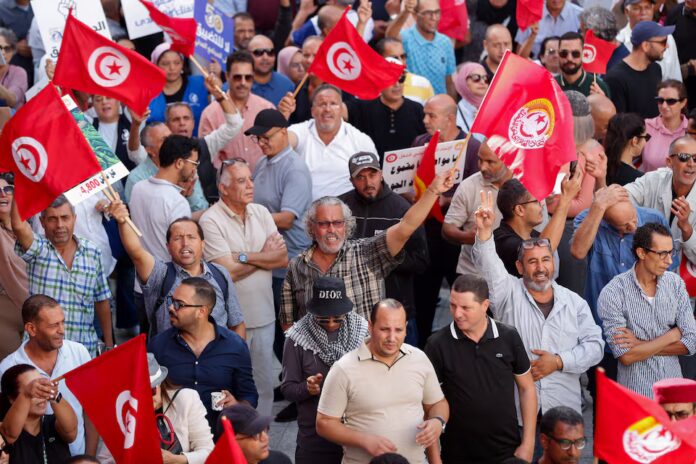

Thousands of Tunisians took to the streets of the capital on Saturday in the largest protest against President Kais Saied in years, demanding an end to political repression and condemning his government’s failure to ease a worsening economic crisis.
The mass demonstration brought together opposition parties, trade unions, lawyers, doctors, journalists, unemployed people and civil society groups in an unusual show of unity against Saied, whose consolidation of power has fuelled years of political tensions.
Led by the powerful Tunisian General Labour Union (UGTT) and civil society organizations, protesters marched along Habib Bourguiba Avenue, the symbolic heart of the 2011 uprising that helped ignite the Arab Spring.
The rally signalled a renewed effort to challenge Saied’s leadership after years of divisions weakened the opposition’s ability to mobilize large crowds.
Public anger has intensified amid deteriorating public services, recurring water and electricity cuts, and shortages of medicines and other essential goods, adding economic hardship to mounting concerns over civil liberties.
Saied expanded his powers in 2021 and 2022, dissolving parliament, dismissing dozens of judges and ruling by decree. Opponents described the moves as a coup, while rights groups have accused his administration of intensifying its crackdown on civil society, journalists and opposition figures.
The president has rejected allegations of authoritarian rule, insisting he is not a dictator. He has also accused his opponents of exploiting economic difficulties to stir social unrest.
Addressing the rally, UGTT leader Slah Eddine Salmi called for an end to the concentration of power in one person’s hands, arguing that Tunisia could not be built around a system dominated by a single individual.
Hundreds of police officers were deployed across the capital as demonstrators demanded the release of Saied’s critics and an end to what they described as attacks on trade union rights.
Protesters chanted slogans linking political repression to worsening living conditions, declaring that power belonged to the people and denouncing hunger amid overcrowded prisons. They also revived the iconic call for the fall of the regime that defined Tunisia’s 2011 revolution.
Banners highlighted unemployment and pollution, underscoring the breadth of grievances confronting the government.
Yassine Gharseli, who travelled from Sfax, about 250 kilometres south of Tunis, said repeated water and electricity cuts had deepened public frustration. He said he had joined the march to defend his freedom and would continue resisting, even if he became the country’s last dissenting voice.
The demonstration brought together political and social groups from across the spectrum, raising the prospect of renewed pressure on Saied as economic hardship and restrictions on civil liberties continue to drive public discontent.