

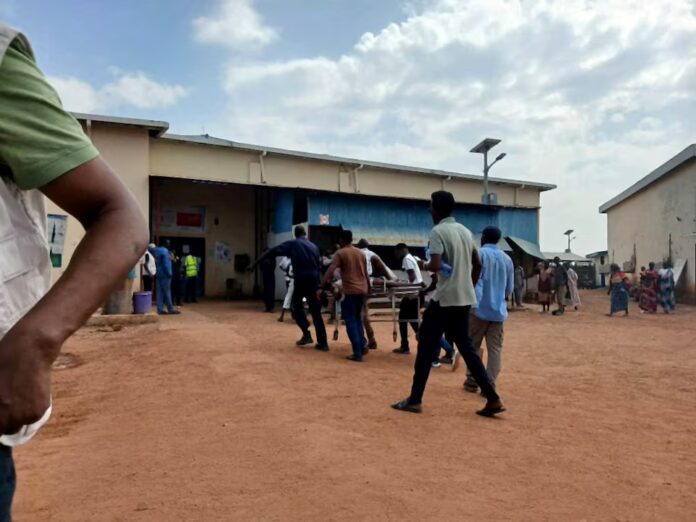

A drone strike on a market in the disputed Abyei region has killed at least 153 people and displaced about 8,000 others, according to local authorities, in one of the deadliest attacks reported in the area in years as Sudan’s civil war increasingly threatens communities beyond its borders.
The attack occurred around midday on Monday, when drones struck a market north of Abyei town. The resulting fires have hampered emergency operations, delaying the recovery of bodies and raising fears that the death toll could climb further.
Yohana Akol Ngor, Abyei’s caretaker information minister, said the confirmed fatalities had risen from an initial 73 to 153 by Tuesday, with rescue teams still struggling to reach victims trapped in the burning market.
Ngor attributed the attack to Sudan’s armed forces but provided no evidence to substantiate the allegation. Sudan’s military had not immediately responded to a request for comment, while the paramilitary Rapid Support Forces (RSF) also did not respond to requests for its reaction.
Three diplomatic sources, an aid worker and a conflict expert told Reuters that the strike hit a fuel depot inside the market. The diplomatic sources said the facility had previously been used by the RSF to supply its fighters.
The circumstances surrounding the attack, including responsibility for the strike and the reported use of the depot, could not immediately be independently verified.
In a statement issued late Monday, South Sudan’s foreign ministry confirmed that drones had struck the market and said it had summoned Sudan’s ambassador to protest the incident. The ministry did not disclose a casualty figure.
Civilian Toll Mounts as Emergency Services Struggle
The devastation has placed additional pressure on an already overstretched healthcare system in Abyei, where medical supplies and access to treatment remain limited.
Médecins Sans Frontières (MSF), the international medical charity, said late Monday that its team was treating more than 20 wounded people at Ameth Bek Hospital, including patients suffering from burns.
Christian Lindauer, MSF’s medical activities manager at the hospital, said the medical team was providing surgical treatment, wound care and other emergency services to those injured in the attack.
Images released by the organization showed patients with bandaged injuries receiving treatment on the hospital floor, underscoring the strain on local medical facilities.
The reported displacement of approximately 8,000 people adds to the humanitarian consequences of the bombing, forcing families from their homes as emergency responders continue recovery operations.
Disputed Territory Caught in Sudan’s Wider War
Abyei occupies a strategically sensitive position between Sudan and South Sudan, both of which have maintained claims to the oil-rich territory since South Sudan became independent in 2011. The region remains jointly administered, and its final status has yet to be resolved.
Its location near Sudan’s Kordofan region, a major theatre of the conflict, has heightened its exposure to the fighting that began in April 2023 between the Sudanese Armed Forces and the RSF.
The two sides have increasingly relied on drone attacks as the war intensifies, with strikes causing civilian casualties and damaging infrastructure across multiple areas.
Officials in Sudan’s military-led government have told Reuters that RSF fighters operate in parts of Abyei. Ngor has rejected claims that the paramilitary force is present in the region, and Reuters said it could not immediately verify either account.
The United Nations Interim Security Force for Abyei (UNISFA) warned in May that an increased RSF presence had worsened insecurity in the territory. The mission also cautioned that the prolonged failure to determine Abyei’s final status was exposing civilians and UN personnel to greater risks.
Although South Sudan’s government maintains that it has remained neutral in the conflict, diplomats and analysts say Abyei has become an important logistical corridor for the RSF, particularly for fuel supplies.
Drone Warfare Spreads Across Borders
The strike comes amid a wider escalation in drone warfare between Sudan’s military and the RSF.
A series of attacks this week targeted Nyala, a city held by the RSF, and Khartoum airport, which is under military control.
Sudanese rights group Emergency Lawyers has also reported that dozens of people were killed in attacks on October 17 and 18 in al-Muglad, in West Kordofan state, which the group attributed to the Sudanese army.
Beyond Sudan’s borders, Chadian authorities have accused Sudan’s military of launching drone strikes on Chadian territory. United Nations experts have said parts of Chad are regularly used along RSF supply routes. Sudan’s foreign ministry said in late August that the armed forces were acting to safeguard the country’s security.
Earlier, on October 10, an airstrike near Sudan’s border with Egypt killed more than 70 artisanal miners, according to a local rights group.
The latest attack highlights the growing risks posed by the conflict’s expanding use of aerial weapons, particularly in areas where civilians, commercial activity and military supply networks may overlap.
Abyei has long experienced recurring violence, often involving rival ethnic communities and armed militias. However, the market bombing stands out for its reported scale of civilian deaths and the destruction that has complicated rescue efforts.
With fires still burning and emergency workers continuing to recover bodies, local authorities fear the confirmed toll may rise further. The attack has also intensified concerns about the vulnerability of civilians in a contested territory increasingly exposed to the wider war and its regional consequences.