

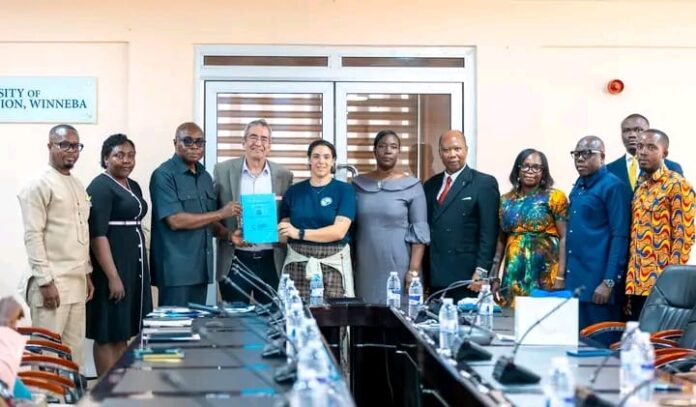

A disability device has limited value if it is unaffordable, inaccessible or impractical to use. It is a promise yet to be fulfilled. That is why the University of Education, Winneba’s (UEW) agreement with Engineers Without Borders Israel to establish an Assistive Technology Innovation Hub deserves attention beyond a ceremonial handshake. Signed during Israeli Ambassador Roey Gilad’s visit in October 2026, the initiative could connect Ghanaian needs with Israeli technical experience, and turn bilateral relations into measurable improvements in daily life. Its strategic value, however, will be judged not by the memorandum itself, but by whether people can obtain, maintain and use the technologies they need.
The scale of the challenge is global. The World Health Organization (WHO) estimates that 2.5 billion people need at least one assistive product, including wheelchairs, hearing aids, prostheses, spectacles and communication software; the figure could exceed 3.5 billion by 2050. A joint WHO-UNICEF report found that nearly one billion people are denied access, with availability in some low-income settings reaching only three per cent of need. These products are essential tools for education, employment, communication, mobility and independent living.
Ghana’s own data demands care as well as urgency. The 2021 Population and Housing Census recorded disability across functional domains, but figures depend on the questions and definitions used; a single headline percentage can conceal differences in seeing, hearing, walking, remembering or self-care. Ghana needs disaggregated evidence on who needs which products, where services are missing, and what families can afford. The proposed hub can help generate that evidence through research and community screening, provided its findings are shared with public agencies and disability organizations.
Local Design, Not Imported Dependence
The hub’s strongest promise is its emphasis on appropriate technology: affordable, practical devices designed around local conditions rather than imported solutions that may be expensive to repair or unsuitable for daily use. According to UEW’s account of the partnership, Engineers Without Borders Israel intends to transfer skills so students and local professionals can design and produce devices, while Alyn Hospital specialists will support adaptation for children and people requiring rehabilitation. The collaboration also envisages training and research, including work on hearing and communication.
A wheelchair must cope with local roads, buildings and transport; a communication aid must work in the languages and environments where it will be used. A hearing device is valuable only if fitting, follow-up and maintenance are available. But “local” must not become a synonym for low quality. Devices require user testing, safety standards, clinical input and reliable replacement parts. People with disabilities must help define the problems and evaluate prototypes, not merely receive finished products.
UEW is a logical anchor because its expertise in teacher education, special needs education and audiology can connect technology with classrooms and community services. Its existing hearing-screening work offers a possible route from detection to support. Yet screening without referral, diagnosis and affordable treatment risks identifying needs that the system cannot meet. The hub should therefore build formal links with health facilities, schools, rehabilitation professionals and social protection services.
A Strategic Partnership Beyond Ceremony
For Ghana, the agreement offers a chance to deepen health innovation, inclusive education and technical skills while making international cooperation answer practical national priorities. For Israel, it creates a channel for sharing engineering and rehabilitation expertise through a people-centred partnership. Israel’s embassy identifies stronger government-to-government, business-to-business and people-to-people ties as objectives of its engagement with Ghana. A disability innovation hub can give that relationship a concrete public-service dimension, where results are visible in schools, clinics and homes.
Sustained collaboration can build professional relationships and trust around a defined human need. Joint research, staff exchanges, co-supervised student projects and transparent publication of results would be more durable than one-off donations. The participation of Alyn Hospital and audiology specialist Professor Josée Lagacé of the University of Ottawa, reported by UEW, also points to a wider network of expertise. Ghana should use such links to strengthen its own institutions, not leave critical knowledge concentrated in visiting specialists.
The model could also encourage African-centred innovation. If products are designed and tested in Winneba with users, engineers, teachers and clinicians, lessons may be relevant to other countries facing similar affordability and infrastructure constraints. Replication will depend on evidence, financing, standards and partnerships with regional disability organizations. Intellectual property and commercial arrangements must be transparent so public-interest research does not leave users paying prohibitive prices for devices developed with their participation.
Turn the MoU into Measurable Access
A memorandum is a framework, not a service. Ghanaian and Israeli partners should publish a funded implementation plan with timelines, governance arrangements and clear responsibilities. It should set measurable targets for devices developed, tested, repaired and supplied; professionals trained; schools and clinics reached; and users reporting improved participation. Baseline data are essential if progress is to be demonstrated rather than asserted.
Funding must cover the full life cycle: research, materials, testing, fitting, training, repairs and replacement. The hub should publish annual results, costs and user feedback, with independent evaluation and accessible complaint mechanisms. Ghana’s obligations under the UN Convention on the Rights of Persons with Disabilities reinforce the principle that inclusion is a rights issue, not charity. The WHO’s assistive-technology framework stresses people, policy, products, provision and personnel; a workshop alone cannot deliver that system.
A starting point would be a needs assessment in Winneba and nearby districts, followed by co-designed pilots. Results should record not only unit cost, but durability, repair time, user satisfaction and whether devices improve attendance, communication or daily functioning. Publishing these measures would help policymakers decide which solutions merit wider investment independently.
The partnership’s strategic test is straightforward. Can it help a child hear and participate in class, enable a student with mobility limitations to reach a lecture or allow an adult to communicate, work and live with greater independence? If it can, Ghana gains skills and services, while Israel gains a credible partnership grounded in practical results. If it produces equipment without maintenance, research without public access or promises without budgets, its potential will be lost. The MoU opens a door. The measure of diplomacy is whether people with disabilities can walk, roll, hear, learn and participate more freely through it.