

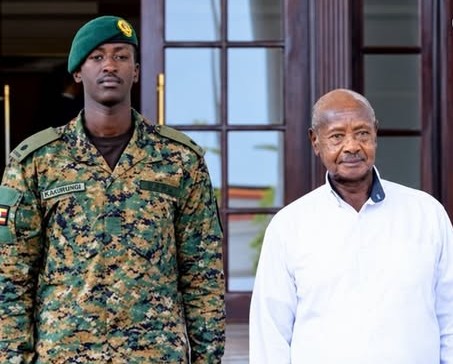

A republic is not a family inheritance. Yet Uganda’s President Yoweri Museveni has presided over a development that should trouble every African who believes public institutions belong to citizens, not ruling families: the commissioning of his grandson, Ruhamya Kainerugaba, as a second lieutenant in the Uganda People’s Defence Forces (UPDF). The ceremony, held at the Uganda Military Academy in Kabamba on October 20, 2026, placed a third generation of the president’s family in uniform. Ruhamya’s father, General Muhoozi Kainerugaba, commands the armed forces; his grandfather has governed Uganda since 1986. The symbolism is impossible to ignore.
To be clear, family relationships alone do not prove corruption, incompetence or an improperly awarded commission. Ruhamya completed a 44-week officer-training course at Britain’s Royal Military Academy Sandhurst, graduating in August 2026. He was among approximately 280 officer cadets commissioned at Kabamba. These are relevant credentials, and professional training deserves recognition. But qualifications do not eliminate legitimate questions about privilege, equal opportunity and the boundaries between public authority and family influence. When the head of state commissions his own grandson into an institution commanded by that grandson’s father, appearances matter profoundly.
The question is not whether Ruhamya can become a competent officer. It is whether Uganda’s military system can demonstrate, convincingly and transparently, that family connections neither confer unfair advantages nor influence future advancement. In a republic, merit must be visible, procedures must be defensible and public institutions must withstand scrutiny. Without transparent answers, even a formally legitimate appointment can deepen suspicions that proximity to power offers advantages unavailable to ordinary citizens.
Three Generations, One Institution, Too Many Questions
The family’s military involvement extends across three generations. Museveni emerged from the guerrilla struggle that brought the National Resistance Movement to power in January 1986. His son, Muhoozi, graduated from Sandhurst in 2000 and eventually rose to become UPDF chief of defence forces. Ruhamya’s commissioning now extends that military lineage into a third generation.
There is nothing inherently improper about successive generations choosing military careers. Soldiers’ children may possess familiarity with discipline, training and service. The decisive issue, however, is whether a national army remains institutionally independent of the political fortunes and personal interests of one family. The UPDF is not a private security organization. Its authority derives from the state, its resources ultimately come from the public, and its loyalty must be to Uganda’s constitutional order rather than to any individual household.
This distinction is particularly important because the president’s son occupies the military’s highest professional command position while the president himself remains commander-in-chief. That concentration of familial relationships across the political and military hierarchy creates a serious governance concern, even without proof of wrongdoing. Effective civilian control requires more than a civilian title at the top; it requires accountable institutions, credible oversight and safeguards against personalized command.
The commissioning ceremony reportedly included eleven female officers among the 280 cadets. That figure offers a useful reminder: the armed forces draw talent from a much wider national pool than one prominent family. Ugandans deserve confidence that recruitment, training, promotion and command appointments reward demonstrable ability. The army’s credibility depends not merely on producing qualified officers but also on convincing citizens that its opportunities are accessible, its standards consistent and its leadership answerable to the law.
Africa’s Presidencies Are Not Crowns
Uganda’s military succession story belongs to a broader continental problem: presidents who increasingly behave as though political office is personal property. Museveni, now 82, has spent approximately 40 years in power and was sworn in for a seventh term in May 2026, extending his presidency through 2031. Cameroon’s Paul Biya, aged 93, has governed since 1982; Equatorial Guinea’s Teodoro Obiang Nguema Mbasogo has ruled since 1979. As of October 2026, seven African presidents have each held office continuously for at least 20 years. These are not merely biographical curiosities. They reveal how difficult political renewal has become in parts of the continent. Teodoro Obiang Nguema Mbasogo and other leaders of his ilk illustrate how prolonged rule can become an organizing principle of government rather than a temporary exception.
Age alone does not establish incapacity. Experience can be valuable, and no responsible democracy should assume that a person becomes unfit to govern simply upon reaching a particular birthday. The problem arises when advanced age coincides with prolonged incumbency, weakened competition, restricted political space and the absence of credible succession arrangements. Leadership is a responsibility, not a lifetime entitlement. A president who cannot imagine the country succeeding without him has confused personal importance with national necessity.
The demographic contrast makes the issue more urgent. A 2023 Mo Ibrahim Foundation analysis placed Uganda’s median population age at approximately 16.3 years, against Museveni’s then-age of 79. The continent’s youthful populations face unemployment, educational pressures, technological disruption and demands for meaningful political participation. They cannot reasonably be expected to accept indefinitely that the same generation must monopolize leadership while their own futures remain uncertain.
Nor can incumbents credibly defend indefinite rule by invoking popular support alone. Afrobarometer research published in 2023 found that an average of 76 per cent of respondents across 34 African countries supported limiting presidents to two terms. Even among respondents who trusted their presidents, 73 per cent supported term limits. These findings expose a fundamental distinction between loyalty to a leader and commitment to democratic rules. Citizens can appreciate a president’s achievements without granting him permanent ownership of the state.
The Cost of Refusing to Leave
Personalized rule carries strategic costs beyond electoral politics. Where military appointments appear entangled with family relationships, professional officers may question whether advancement depends on competence or connections. Such perceptions can damage morale, weaken institutional cohesion and complicate succession during a crisis. In security establishments, the appearance of divided loyalties can be almost as damaging as demonstrable misconduct.
Uganda’s regional responsibilities make institutional credibility especially important. Its armed forces have participated in operations against armed groups, including al-Shabaab in Somalia and remain relevant to security calculations across East Africa. A professional, disciplined military is a national asset. Its standing should rest on operational effectiveness, accountability and constitutional loyalty, not on the political prominence of individual families. The government should therefore make relevant recruitment and promotion procedures transparent, with independent oversight capable of addressing reasonable concerns without prejudging any officer’s integrity.
Presidents who refuse to prepare orderly departures also expose their countries to dangerous uncertainty. When institutions revolve around one individual, succession becomes a contest over access, patronage and coercive power. The departures of Angola’s José Eduardo dos Santos after 38 years in office and Zimbabwe’s Robert Mugabe after 37 years demonstrated different ways entrenched leadership can end. Neither case offers a simple template, but both underline the risks of postponing political renewal until crisis determines the outcome.
Museveni’s defenders can point to continuity, security achievements and development ambitions. These arguments deserve examination, not automatic dismissal. Yet stability cannot mean preserving one leader indefinitely, and development cannot excuse the erosion of institutional independence. Genuine strength lies in building systems that function when a president retires, loses an election or dies.
Ruhamya’s commission should therefore be judged through a broader question: what kind of republic is Uganda building? His military career may prove distinguished. That possibility does not diminish the need for safeguards ensuring the army belongs equally to all Ugandans. The same principle applies across Africa. Presidents must respect constitutional limits, cultivate credible successors and leave office without treating departure as national catastrophe.
The presidency is a public trust, not a throne. The army is a national institution, not a family inheritance. And leadership is not measured by how long a ruler can remain in power, but by whether the country can prosper after he leaves.