

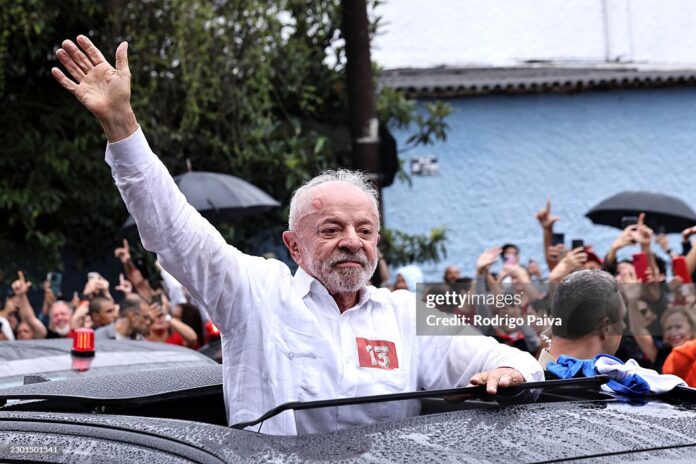

Brazilian President Luiz Inácio Lula da Silva has secured an unprecedented fourth presidential term, defeating Senator Flávio Bolsonaro by more than four million votes in a dramatic runoff that defied pre-election expectations and delivered a setback to the growing influence of the political right across Latin America.
The electoral victory, confirmed by Brazil’s electoral court on Sunday, marks a remarkable political comeback for the 80-year-old left-wing leader, whose campaign overcame mounting public dissatisfaction, economic concerns and the enduring influence of the Bolsonaro political dynasty.
However, the result immediately triggered a political confrontation, with Flávio Bolsonaro refusing to concede defeat and threatening legal action to have the election annulled. He argued that a Supreme Court justice’s decision to extend voting by two hours on Sunday undermined the credibility of the process.
Flávio, the eldest son of former president Jair Bolsonaro, entered the runoff after finishing ahead of Lula in the first round. His eventual defeat, however, was more than twice the margin by which his father lost the 2022 presidential election, dealing a significant blow to the family’s political ambitions.
The dispute has revived memories of Jair Bolsonaro’s refusal to acknowledge his defeat four years ago. The former president subsequently received a 27-year prison sentence from Brazil’s Supreme Court for plotting a coup to retain power.
Despite the latest challenge, analysts consider an annulment highly improbable, particularly given the scale of Lula’s victory and the fact that the Bolsonaro campaign had itself sought an extension of voting hours because of heavy rainfall in the conservative southern region.
Mario Braga, a Latin America analyst at risk consultancy RANE, warned that the defeat could provoke demonstrations by Bolsonaro supporters in the coming days but said the likelihood of such protests overturning the electoral outcome remained extremely low.
Financial markets reacted sharply to Lula’s victory, exposing the extent to which investors had positioned themselves for a change of government. A Tokyo-listed exchange-traded fund tracking Brazil’s Bovespa index plunged nearly 15 per cent during Asian trading, while the Brazilian real faced expectations of a steep decline against the US dollar.
The market turbulence is expected to intensify as investors reassess their positions in the aftermath of an election that has frustrated expectations of a Bolsonaro administration.
For Lula, the victory represents another extraordinary reversal in a political career spanning five decades. Once a metalworker and trade union leader, he has become the most influential figure in Brazilian politics this century and a prominent voice of the international left.
His political fortunes appeared to collapse when he was imprisoned between 2018 and 2019 over corruption convictions that were subsequently overturned. The legal developments restored his political eligibility and cleared the path for his successful 2022 challenge against Jair Bolsonaro.
Federal lawmaker Erika Hilton, who followed the election results alongside Lula in São Paulo, described his return to power as a defining moment for Brazil’s political establishment, portraying him as a leader whose influence extends beyond the country’s borders.
The campaign was far from straightforward. Years of corruption controversies involving Lula’s Workers’ Party, rising living costs and profound changes in Brazil’s economy had weakened enthusiasm for the veteran president. His traditional political appeal also faced the challenge of connecting with younger voters and an expanding informal workforce increasingly dependent on digital platforms.
Nevertheless, stronger-than-anticipated voter participation proved decisive. Leonardo Barreto, co-founder of consultancy Think Policy, attributed Lula’s victory to voters’ preference for political familiarity and established social protections over the uncertainty associated with a Bolsonaro presidency.
Lula built much of his campaign around his administration’s record on poverty reduction, inequality and social development. He also highlighted improvements in employment, literacy and environmental protection during his third term, presenting his government as a more dependable option for economically vulnerable Brazilians.
He warned that a Bolsonaro victory could undermine social protections, reverse progress on social inclusion and weaken Brazil’s independence in the face of pressure from US President Donald Trump.
That argument carried significant international implications. Lula’s victory denies Trump another influential right-wing ally in Latin America, where an expanding group of conservative governments has increasingly aligned itself with Washington’s positions on immigration and security.
The US State Department had previously spearheaded efforts to support the Bolsonaros’ return to power. Neither Trump nor the department immediately issued a response to the Brazilian election outcome, although Canadian Prime Minister Mark Carney and several Latin American leaders quickly congratulated Lula.
Celso Amorim, a former Brazilian foreign minister under Lula, argued that the president’s return would provide an important counterweight to the growing ideological divisions shaping Latin American politics.
Lula’s victory also breaks a significant electoral precedent. He becomes the first presidential candidate since Brazil restored democracy in the 1980s to win an election after finishing second in the initial round of voting.
His campaign combined political pragmatism with expansive social promises, reflecting the approach that has sustained his influence throughout decades in public life. Among his proposals were nationwide free public transport at weekends and an increase in benefits under his flagship welfare programme, with the latter already being implemented.
He also championed a constitutional amendment that became Brazil’s most significant labour reform in decades, securing broad support in Congress.
Yet the electoral triumph could usher in the most politically challenging chapter of his presidency. Brazilians have elected their most conservative Congress since the restoration of democracy, leaving Lula facing a legislature with substantial opposition influence.
The Liberal Party, led by Bolsonaro, and its political allies could command more than 280 seats in the lower house and as many as 50 in the Senate, giving conservative lawmakers considerable leverage over legislation and government priorities.
Such numbers could further strengthen Congress at the expense of the presidency, particularly over public spending, major legislative decisions and important political appointments.
The political challenge comes alongside mounting economic pressures. Brazil’s government projects economic growth of just 2.3 per cent next year, while elevated interest rates, rising public debt and growing fiscal constraints threaten to complicate Lula’s spending ambitions. Public debt has already exceeded 82 per cent of gross domestic product, its highest level since the pandemic.
Goldman Sachs expects only limited progress in reducing government expenditure under Lula’s fourth administration, citing his continued commitment to a state-led economic development model.
Household indebtedness presents another significant concern. Lula attempted to address the problem during the campaign through a temporary prohibition on online betting and the introduction of a new debt-relief initiative.
Meanwhile, economists expect the incoming conservative-dominated Congress to pursue structural reforms favourable to businesses, potentially forcing reductions in public expenditure. Such measures could generate widespread opposition if they threaten social programmes and other benefits enjoyed by ordinary Brazilians.
Lula therefore begins his unprecedented fourth term with a historic electoral mandate but without an equally favourable political environment. His ability to protect his social agenda, restore investor confidence and govern effectively alongside a powerful conservative legislature will determine whether his latest comeback becomes another defining success or the most difficult test of his political legacy.