

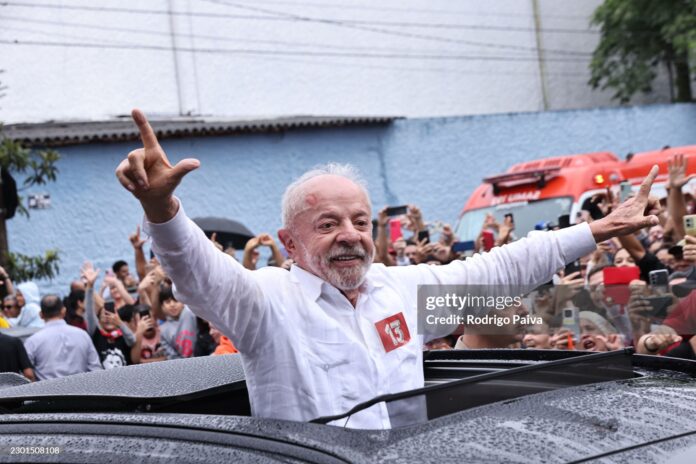

Brazil has delivered its verdict. The far right has lost another presidential contest, but it has not lost its grip on the country’s politics. President Luiz Inácio Lula da Silva’s re-election is a significant victory for the Brazilian left, a personal political triumph for one of Latin America’s most consequential leaders and a setback for the Bolsonaro movement. Yet the circumstances surrounding the result reveal a democracy still struggling with deep ideological divisions, institutional distrust and an increasingly aggressive contest over political legitimacy.
Lula secured 64,256,232 votes, representing 51.79 per cent of valid ballots, against 59,826,041 votes or 48.21 per cent, for Senator Flávio Bolsonaro, according to Brazil’s Superior Electoral Court (TSE). The margin was 4,430,191 votes. Though decisive, the result was far from a national political consensus. More than 59.8 million Brazilians voted for Bolsonaro, demonstrating that the right retains an enormous electoral constituency capable of challenging the governing left.
The scale of Lula’s achievement becomes clearer against the background of his political history. Having governed Brazil from 2003 to 2010 and returned to office in January 2023, he has now secured an unprecedented fourth presidential term, becoming the first Brazilian president to achieve that distinction. At 80, he has also demonstrated an extraordinary capacity for political survival, overcoming corruption controversies, imprisonment, disqualification and the political collapse of his party before returning to the presidency.
But this victory should not be interpreted as an ideological conversion of Brazil. It is evidence that Lula’s coalition remained sufficiently broad to defeat a powerful conservative challenger in a closely divided country. The nuance is where the significance lies. Electoral victory establishes authority to govern; it does not automatically establish public agreement with the government’s programme.
The Extension Dispute
The challenge threatens to turn a narrow victory into an institutional confrontation. Flávio Bolsonaro has refused to concede and says he will seek annulment, citing Supreme Court Justice Cristiano Zanin’s last-minute decision to extend voting by two hours. The controversy deserves scrutiny, but it does not make allegations of manipulation established fact. The extension followed requests from both campaigns: Lula’s team cited public-transport disruptions, while Bolsonaro’s pointed to severe rain, flooding and blocked roads in the south. Zanin ordered voting to continue until 7 p.m., but polling stations already closed were not to reopen. The timing caused confusion, as some officials received the order only after closing, prompting the electoral court to temporarily pause the count.
These circumstances raise legitimate questions about communication, equal access and ballot administration. Yet both campaigns sought additional time, weakening claims that the measure was designed exclusively to benefit Lula. The final count covered all electoral sections, recording 128.2 million voters from an electorate of approximately 158.7 million. Turnout reached 80.8 per cent, while abstention stood at 19.2 per cent. Ultimately, annulment requires evidence that legally significant irregularities compromised the result, not merely that a decision was controversial or poorly communicated.
The courts must examine any properly filed challenge transparently, while electoral authorities should explain which polling places were affected and how votes were secured and counted. Due process is essential, but so is restraint: political leaders cannot demand institutional credibility only when outcomes favour them. Voters deserve a full, public explanation grounded in verifiable evidence and official records.
The Economic Test Behind the Ballot
Lula’s victory also reflects economic performance and the distribution of its benefits. Brazil’s economy expanded by 2.3 per cent in 2025, its fifth consecutive year of growth, according to IBGE. Annual unemployment fell to 5.6 per cent, the lowest since the current series began in 2012, while employment reached a record 103 million. These figures gave the incumbent a credible record, particularly among workers and lower-income households. However, headline numbers conceal underlying weaknesses. Growth slowed from 3.4 per cent in 2024, and the IMF projected 1.9 per cent growth for 2026 in its April outlook. Its July assessment forecast 5.6 per cent year-end inflation. Reuters reported public debt above 82 per cent of GDP and a policy interest rate of 13.75 per cent. High borrowing costs, household debt and constrained public finances will limit ambitious social spending.
Lula must protect income-support programmes and investment without undermining fiscal confidence. He must also address productivity, education, infrastructure and tax reform. A fourth term cannot rest on the symbolism of his return. It must improve living standards while convincing investors and Congress that economic policy is sustainable.
A Regional Signal, and a Warning for Lula
The result matters beyond Brazil, Latin America’s largest economy and an influential diplomatic actor. Lula’s re-election denies the regional right a major symbolic victory and preserves a government prioritizing multilateral diplomacy, climate negotiations and ties with developing economies. It complicates claims that the Bolsonaro model is the inevitable answer to insecurity and public frustration. But Brazil is not a regional plebiscite. The result cannot erase conservative strength elsewhere or suggest voters have rejected the right’s entire agenda. Flávio’s 48.21 per cent provides a formidable foundation for continued mobilization, while the Bolsonaro family retains influence and the close result gives the opposition incentives to scrutinize the government and test institutional trust.
Lula’s first task is to govern beyond his electoral base. He must recognize those who voted against him, rebuild confidence in public institutions and avoid turning every dispute into a battle between democracy and extremism. The opposition, in turn, must distinguish legitimate legal scrutiny from attempts to delegitimize an outcome without evidence. Both sides have a responsibility to protect democratic institutions and prevent political competition from deepening existing divisions.
Brazil has chosen continuity, not issued a blank cheque. The fourth mandate is a remarkable comeback and a setback for the far right; it is also a test of democratic maturity. If Lula delivers competent government, economic stability and social inclusion, he can strengthen the institutions that returned him to office. If he mistakes a narrow majority for unquestioning consent, the divisions exposed by this election will deepen. The ballot has settled who won. It has not settled what Brazil becomes next.