

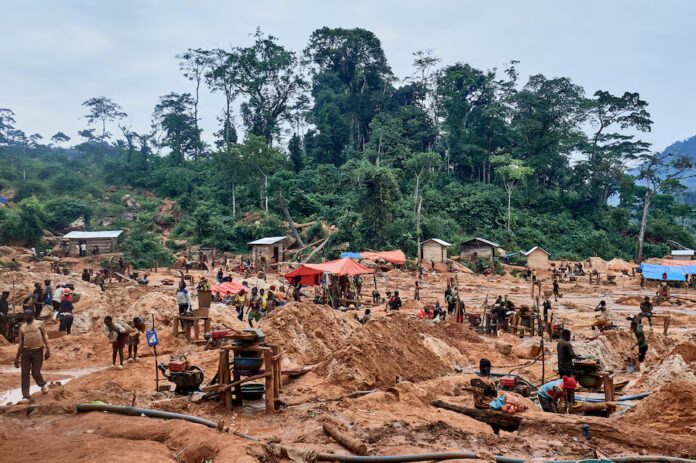

An Islamic State-linked rebel group operating in eastern Democratic Republic of Congo is financing much of its deadly insurgency through gold mining and smuggling, exploiting the region’s mineral wealth to sustain its operations despite military offensives and international sanctions, a new investigation has revealed.
The Allied Democratic Forces (ADF), blamed for thousands of deaths among civilians and security personnel over the past decade, generates an estimated $1 million to $1.6 million annually from gold mining operations in just one area of North Kivu province, according to a report released Tuesday by US-based investigative organization The Sentry.
The proceeds are channelled through trading centres in eastern Congo before the gold enters cross-border trafficking networks, including routes leading to refiners and export markets in neighbouring Uganda.
The findings expose how the insurgents have entrenched themselves in the region’s illicit mineral economy, turning gold extraction and trafficking into a critical financial lifeline at a time when international pressure has sought to weaken their operations.
Despite Uganda deploying thousands of troops to support Congolese forces against the group, the ADF has demonstrated considerable resilience, maintaining links with local economic networks and exploiting remote mining communities.
The Sentry report indicates that income from gold has significantly reduced the group’s dependence on financial assistance from Islamic State since late 2024, following US sanctions against key individuals facilitating its financial networks.
Beyond gold, the insurgents reportedly raise funds through cocoa production, extortion and kidnapping, creating multiple revenue streams to sustain their activities.
The Sentry’s executive director, Justyna Gudzowska, said the group had responded to military offensives and financial restrictions by expanding its involvement in the trafficking of gold and other natural resources.
She warned that efforts to dismantle the insurgency must extend beyond military operations to target the commercial networks sustaining its finances, particularly the financiers, gold dealers and intermediaries facilitating the trade.
Ugandan military and government officials, as well as representatives of the Congolese government, had not immediately responded to requests for comment.
Originally established in Uganda in the 1990s as an Islamist movement, the ADF relocated much of its operational base to eastern Congo by 2000. It formally pledged allegiance to Islamic State in 2019, subsequently receiving support from the group’s central leadership.
That alliance transformed the ADF from a largely local insurgency along the Uganda-Congo border into part of a wider transnational jihadist network. The group has since staged several bomb attacks in Uganda and recruited fighters from across the region.
Joint military operations by Uganda and the Democratic Republic of Congo, launched in late 2021, succeeded in securing major towns and strategic trade routes but failed to eliminate the insurgency.
Instead, the ADF splintered and pushed further into remote mining territories across North Kivu, Ituri and Tshopo provinces, where it has increasingly exploited the informal mineral economy, The Sentry reported.
A representative of a Congolese mining cooperative said the insurgents moved into the area around mid-2024, establishing bases close to mining sites.
The representative, who requested anonymity over security concerns, disclosed that the group had abducted miners and prospectors, forcing them to extract, transport and sell gold on its behalf.
Some local residents also reportedly collaborated with the insurgents in exchange for financial rewards, creating an economic network sustained by both intimidation and monetary incentives.
The revelations highlight the growing financial dimension of the conflict in eastern Congo, where the ADF continues to operate despite sustained military pressure.
Its activities have also received comparatively less international attention as the spotlight remains fixed on the Rwanda-backed AFC/M23 rebellion, now known as FRN, which captured extensive territory across eastern Congo last year.