


The United States is preparing for another confrontation with Iran, and this time Washington appears determined to have its military machinery in position before pulling the trigger. A Patriot missile defence system is being moved from Texas to the Middle East, American forces are repositioning personnel away from vulnerable bases, ammunition stocks are being replenished, and additional naval assets are being assembled for a potential resumption of major combat operations. The timing is particularly significant. With the November 3 midterm elections approaching, the Trump administration is increasingly signalling that the window for military escalation could open once American voters have cast their ballots.
The latest revelations, reported by The Wall Street Journal on October 28, represent a significant escalation in the preparations for a possible renewed military campaign. According to people familiar with diplomatic and military communications, Washington has informed several Gulf Arab governments that they should prepare for a potentially short but intensive military operation against Iran after the elections. The United States is also transferring a Patriot air defence battery from Texas to the region, while reinforcing its capacity to sustain offensive operations and protect American installations against Iranian retaliation.
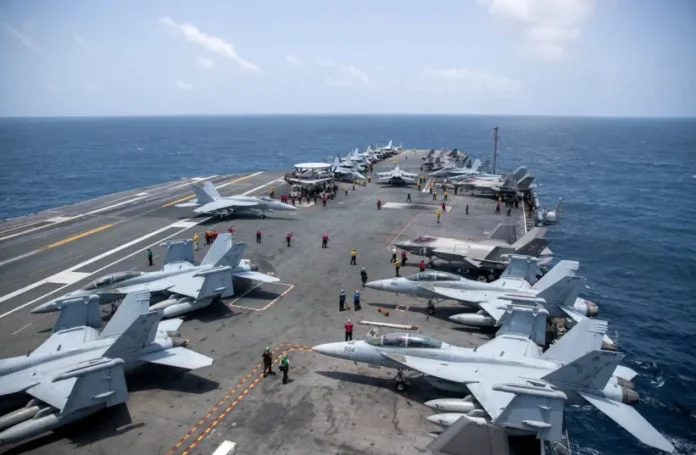
These are not isolated military movements. They form part of a broader effort to establish the operational conditions necessary for a rapid return to war. The Pentagon is reportedly preparing bombers and fighter aircraft, replenishing precision-guided munitions and moving personnel away from installations considered particularly exposed to Iranian missile and drone attacks. An additional aircraft carrier strike group and a Marine expeditionary unit are also expected to join approximately 20 American warships operating in the Middle East next month.
The significance of these preparations lies in their coordination. Moving air defence systems, protecting personnel, replenishing weapons and expanding naval capabilities are different components of the same military calculation: ensuring that Washington can conduct another major offensive without leaving its regional forces dangerously exposed.
Nevertheless, military readiness should not be confused with a final decision to attack. President Donald Trump has not publicly authorized a renewed offensive, and the White House has maintained that diplomatic possibilities remain open. But the scale of the reported preparations suggests that the administration wants the option of military action available at short notice.
The Patriot Deployment
The transfer of the Patriot missile defence system from Texas deserves particular attention because it illustrates the central vulnerability confronting Washington and its regional partners: Iran’s capacity to retaliate. The Patriot, particularly its advanced interceptor configurations, is designed to defend against incoming ballistic and cruise missiles, aircraft and other aerial threats. Its deployment would strengthen the protection of strategically important installations, military facilities and allied territory against the possibility of another Iranian missile barrage.
For American military planners, this defensive reinforcement is essential. A renewed campaign against Iran would almost certainly expose US bases, logistics hubs, naval facilities and regional partners to retaliation. Tehran has repeatedly demonstrated its willingness to use missiles and unmanned aerial vehicles to impose costs on American and allied forces. Consequently, any decision to resume offensive operations must account for the possibility that Iran could respond beyond the immediate battlefield.
The Patriot deployment also highlights a difficult military reality. Offensive superiority does not automatically guarantee defensive security. American aircraft and naval forces possess formidable technological advantages, but protecting a geographically dispersed network of military installations against simultaneous missile and drone attacks remains a demanding task. The wider naval buildup reinforces this calculation. According to the Council on Foreign Relations, three of America’s 11 aircraft carrier strike groups are expected to be operating in the Middle East region by the end of October. Such a concentration would provide Washington with additional airpower, surveillance capabilities and operational flexibility. Carrier-based aircraft could support strikes against Iranian military installations, while destroyers and other naval vessels would contribute missile defence and maritime security.
Yet the United States is also confronting the consequences of its previous military campaign. A Pentagon estimate obtained by Reuters on October 28 puts the cost of the war against Iran at more than $47 billion, representing an increase of over 25 per cent from the $37.5 billion estimate provided by Defence Secretary Pete Hegseth in July. More than $29 billion is projected to be required to replace expended munitions, while over $6 billion would be needed to replace damaged or lost military equipment, including aircraft and drones. The figures do not clearly account for the full cost of repairing American bases damaged by Iranian attacks.
These numbers expose the enormous financial burden of sustained confrontation. They also explain why replenishing military inventories has become central to Washington’s preparations. A military campaign that consumes expensive precision weapons faster than the defence industry can replace them risks undermining America’s capacity to respond to other strategic challenges.
The Political Calendar Behind Washington’s Military Calculations
The timing of the anticipated military escalation is perhaps as revealing as the military preparations themselves. The November 3 midterm elections will determine control of the US Congress for the next two years. Republicans currently hold narrow majorities in both chambers, making the political consequences of an unpopular foreign military campaign particularly sensitive for the Trump administration.
The war with Iran has already become an electoral liability. According to analysis cited by the Council on Foreign Relations, support for the conflict stands at approximately 33 per cent among Americans. Rising fuel prices and the wider economic consequences of the confrontation have compounded public dissatisfaction, placing additional pressure on Republican candidates. Against this background, Trump’s reluctance to authorize another major offensive before the elections appears politically understandable. On October 22, the White House explicitly told ABC News that the United States would not resume attacks on Iran before November 3. However, American and Israeli officials have simultaneously been developing contingency plans for renewed joint operations in the weeks following the vote.
The distinction is important. Washington may be attempting to separate the immediate political costs of war from the strategic calculations governing its longer-term Iran policy. A post-election offensive would not eliminate domestic opposition, but it could provide the administration with greater political flexibility. Trump would have passed the immediate electoral test and would be less constrained by the prospect of an imminent congressional vote. There is also a broader strategic consideration. The administration appears to believe that a sufficiently powerful military campaign, combined with economic pressure, could force Tehran into accepting American demands on its nuclear programme and regional military capabilities.
However, the assumption that a new offensive would produce a decisive diplomatic breakthrough remains questionable. Previous American and Israeli strikes inflicted substantial damage on Iranian military and economic infrastructure, yet they did not produce a comprehensive political settlement. The April ceasefire provided Iran with an opportunity to recover some underground weapons facilities and restore elements of its missile and drone capabilities, according to Reuters. This illustrates the central contradiction in Washington’s strategy: military superiority can destroy infrastructure, degrade capabilities and impose enormous costs, but it cannot automatically compel political capitulation.
Iran’s Response and the Dangerous Arithmetic of Regional Escalation
For Tehran, the prospect of renewed American and Israeli attacks presents an existential strategic challenge. Iran cannot match the United States in conventional airpower, naval strength or advanced military technology. Its response, therefore, is likely to rely on asymmetric capabilities, including ballistic missiles, drones, regional partnerships and threats against strategically important infrastructure. Iran’s geographical position gives it considerable leverage. The Strait of Hormuz, through which approximately one-fifth of global petroleum liquids consumption passes, remains one of the world’s most important energy chokepoints. Any significant disruption to commercial shipping could trigger an immediate reaction across international oil markets, increasing transportation costs and intensifying inflationary pressures far beyond the Middle East.
A renewed confrontation would also expose American partners across the Gulf to serious risks. Military installations, energy facilities, ports and critical infrastructure could become potential targets if Tehran decides that the objective of retaliation should be to increase the economic and political costs of American intervention. Israel would face its own challenges. Though its integrated air defence architecture provides substantial protection against incoming threats, no missile defence network offers absolute security against sustained, large-scale attacks. A coordinated Iranian barrage could place considerable pressure on interception systems, particularly if attacks involved different missile and drone platforms. The danger, therefore, is that a campaign Washington initially describes as short and intensive could develop into a prolonged regional confrontation.
There is also the question of what constitutes victory. Destroying additional Iranian nuclear facilities, missile installations and energy infrastructure might weaken Tehran’s military and economic position. But it would not necessarily eliminate Iran’s ability to rebuild, retaliate or pursue strategic deterrence. Indeed, another major offensive could strengthen hardliners within the Iranian establishment who argue that diplomatic engagement offers insufficient protection against American military pressure.
For Washington, the strategic choice is becoming increasingly difficult. Continuing the present pressure campaign risks allowing Iran time to rebuild and strengthen its negotiating position, while launching another offensive risks expanding a conflict that has already cost the United States more than $47 billion, potentially destabilizing global energy markets and threatening American personnel throughout the region. The diplomatic alternative remains available, but it requires concessions and guarantees that neither side has yet demonstrated a willingness to accept.
The deployment of additional Patriot missile defence systems from Texas signals far more than a routine reinforcement of American military positions. It reflects a broader strategic calculation in Washington: that diplomacy with Tehran could collapse and another military confrontation may become unavoidable. Though the November 3 elections could influence the political timing of any decision, they are unlikely to alter the fundamental tensions driving the US-Iran standoff. The growing danger is that Washington and Jerusalem may increasingly view renewed military action as the most viable means of achieving the strategic objectives that previous operations failed to secure. Iran, for its part, has little incentive to absorb another round of attacks without demonstrating its capacity to retaliate, potentially extending the consequences of any confrontation well beyond the immediate battlefield.
The region is consequently edging towards another period of heightened instability, with American forces strengthening their defensive capabilities, Israel refining its military options and Gulf states facing the prospect of being drawn into a wider conflict. Whether this expanding military posture is ultimately intended to deter Tehran, strengthen Washington’s negotiating leverage or establish the conditions for a renewed offensive remains an open question. What is increasingly evident, however, is that the United States is preparing for a range of outcomes in which military force is no longer a distant contingency but a realistic strategic option.
The significance of these preparations lies not simply in the weapons being repositioned, but in the message they convey about Washington’s assessment of the crisis. The United States is moving beyond contingency planning and building the operational capacity to sustain another confrontation with Iran should the political decision to act be taken.