

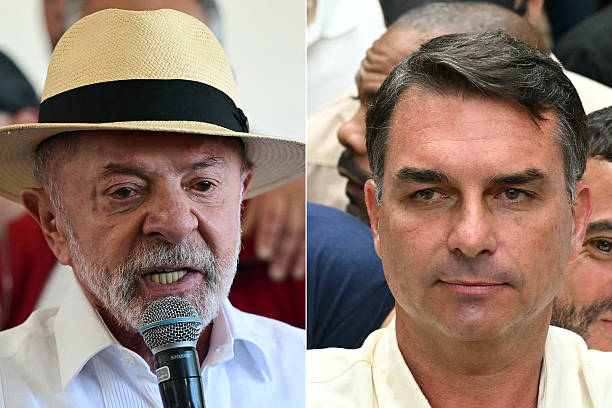

Brazil’s presidential election has produced more than a political defeat. It has opened another dangerous confrontation over the legitimacy of democratic institutions, the authority of the courts and the willingness of political leaders to accept the verdict of the electorate. Flávio Bolsonaro, defeated by incumbent President Luiz Inácio Lula da Silva in Sunday’s presidential runoff, has refused to concede and demanded that the election results be annulled. His challenge threatens to turn an electoral setback into a broader constitutional and political crisis.
The official figures leave little ambiguity about the outcome. According to Brazil’s Superior Electoral Court (TSE), Lula secured 64,256,232 votes, representing 51.79% of valid ballots, while Bolsonaro received 59,826,041 votes or 48.21%. The difference was approximately 4.43 million votes. With all votes counted, Lula was declared the winner and secured an unprecedented fourth, non-consecutive presidential mandate. More than 128.2 million Brazilians participated in the runoff, representing approximately 80.78% of the 158.7 million registered electorate.
Bolsonaro’s refusal to accept the result is particularly consequential because he is not an outsider challenging the political establishment from the margins. He is a serving senator, a prominent figure in Brazil’s conservative movement and the son of former president Jair Bolsonaro. His presidential campaign represented an attempt to consolidate the political inheritance of his father and return the Bolsonaro movement to the centre of national power.
The rejection of the result therefore carries implications extending beyond the ambitions of one politician. It raises the question of whether a major political movement can accept electoral defeat without questioning the legitimacy of the institutions responsible for administering democracy. Losing an election is not evidence of electoral manipulation. Nor does a candidate’s conviction that victory was deserved confer a constitutional entitlement to the presidency.
Supreme Court Dispute and Election Fraud Claims
At the centre of Bolsonaro’s objections is a controversial decision involving Brazil’s Supreme Federal Court. Justice Cristiano Zanin authorized voting to continue for an additional two hours following transportation difficulties and severe weather affecting voters in different parts of the country. The decision came shortly before the scheduled closing of polling stations and generated confusion over the administration of the final hours of voting.
The political sensitivity was considerable. Zanin had previously served as Lula’s lawyer, creating an obvious opportunity for Bolsonaro’s campaign to question the appearance of judicial impartiality. Bolsonaro argued that the rules had effectively been changed during the election and maintained that the circumstances made the result unacceptable. He subsequently called for annulment of the presidential election.
These concerns deserve scrutiny. Electoral authorities must operate transparently, consistently and independently, particularly when decisions are taken during voting. A judicial intervention that changes polling arrangements at the last minute inevitably invites questions about procedural fairness, even where the underlying intention is to protect citizens’ access to the ballot. However, political suspicion is not proof of electoral fraud. The Associated Press reported that both presidential campaigns had requested extensions for different reasons: Lula’s campaign cited transportation difficulties in São Paulo and Salvador, while Bolsonaro’s campaign pointed to heavy rainfall in southern Brazil, where his support was stronger. The circumstances therefore complicate any suggestion that the decision was simply an intervention designed to benefit the incumbent.
Furthermore, the president of the TSE, Kassio Nunes Marques, maintained that the extension did not influence the final outcome. Significantly, Nunes Marques was appointed to the Supreme Federal Court by Jair Bolsonaro himself. An independent assessment of the decision must therefore distinguish between legitimate concerns about judicial procedure and allegations that the entire election was manipulated.
The Carter Centre’s preliminary assessment also offers an important qualification. Its election expert mission commended the administration of the runoff and described the process as organized and transparent, with opportunities for scrutiny by political parties and voters. However, it acknowledged inconsistencies and contradictory judicial decisions, including the controversial extension of voting hours. The mission explicitly stated that its limited observation did not constitute a comprehensive assessment of the entire electoral process. Its findings support continued scrutiny, not an unsupported conclusion that the election was stolen.
Bolsonaro’s Legacy and Election Denialism
The confrontation cannot be understood without examining the political history of the Bolsonaro family. Jair Bolsonaro’s presidency was characterized by fierce ideological polarization, confrontations with the judiciary and repeated attacks on Brazil’s electoral system. His political movement built substantial support around conservative social values, national sovereignty, law-and-order politics and opposition to the Workers’ Party.
Yet the most consequential chapter of that political legacy concerns the country’s institutional stability following the 2022 election. Jair Bolsonaro lost that contest to Lula and subsequently became embroiled in investigations concerning an alleged attempt to prevent the peaceful transfer of power. He is now serving a 27-year prison sentence following his conviction over plotting a coup. The political significance of that history is difficult to ignore as his son challenges another election result.
Flávio Bolsonaro’s political position presents a delicate dilemma for Brazil’s opposition. His campaign demonstrated that the conservative movement remains formidable, despite the legal and political difficulties surrounding his father. Indeed, the first round of the 2026 presidential election demonstrated the movement’s electoral strength. Flávio secured 47.03% of valid votes, equivalent to 56,103,033 ballots, while Lula received 45.16%, or 53,870,724 votes. The runoff, however, reversed that advantage. Lula’s eventual victory demonstrated that first-round momentum does not guarantee electoral success. His campaign mobilized additional support, particularly among younger voters and left-wing constituencies, transforming an initially difficult contest into a historic comeback.
The central danger now is that electoral denialism could become a permanent instrument of political mobilization. By portraying defeat as evidence of institutional conspiracy without producing sufficient evidence, political leaders risk undermining public confidence in elections, courts and constitutional government. This can deepen social divisions, encourage confrontation and weaken the credibility of democratic institutions.
There is, nevertheless, an important distinction between challenging an election and rejecting democracy. Candidates must retain the right to pursue legitimate complaints, request recounts where legally justified and present evidence of irregularities. But such challenges must proceed through established legal mechanisms. They cannot be replaced by political declarations that attempt to substitute personal conviction for constitutional authority.
Brazil’s Democratic Test and Global Impact
Brazil’s political confrontation carries significance far beyond its national borders. As Latin America’s largest economy, with an annual gross domestic product of approximately $2.6 trillion, Brazil occupies a strategically important position in international diplomacy, global trade, energy security and regional political affairs. Its domestic stability matters to investors, neighbouring governments and international partners. Lula’s reelection also has geopolitical implications. His administration has pursued a foreign policy centred on strategic autonomy, multilateral engagement and greater influence for developing countries in international institutions. His victory is particularly significant amid a regional political environment in which several right-wing candidates aligned with US President Donald Trump have enjoyed electoral success.
A prolonged legitimacy dispute could complicate Brazil’s diplomatic priorities, unsettle investor confidence and distract the incoming administration from pressing economic and security challenges. It could also intensify the country’s ideological divisions at a moment when political stability is essential for addressing organized crime, fiscal pressures, economic inequality and the broader demands of national development. International observers therefore have an interest in two principles operating simultaneously: electoral authorities must remain accountable, and political candidates must respect verifiable election results. The Carter Centre has urged candidates and their supporters to respect the announced outcome while insisting that evidence-based concerns should be pursued through established legal procedures.
Ultimately, the defining question is not whether Flávio Bolsonaro believes he should have won, but whether he can substantiate his allegations through the institutions established to resolve electoral disputes. If credible evidence emerges, it must be investigated. If it does not, the result must stand. Brazilian democracy cannot function on the principle that elections are legitimate only when a particular political faction wins. Lula’s victory does not place his government above judicial scrutiny, just as Bolsonaro’s defeat does not entitle him to disregard the electorate’s decision.
The stakes are considerable. Brazil must demonstrate that its democratic institutions can withstand intense political pressure without surrendering their constitutional responsibilities. The election has produced a winner; what remains to be tested is whether its political leadership can accept that reality.