

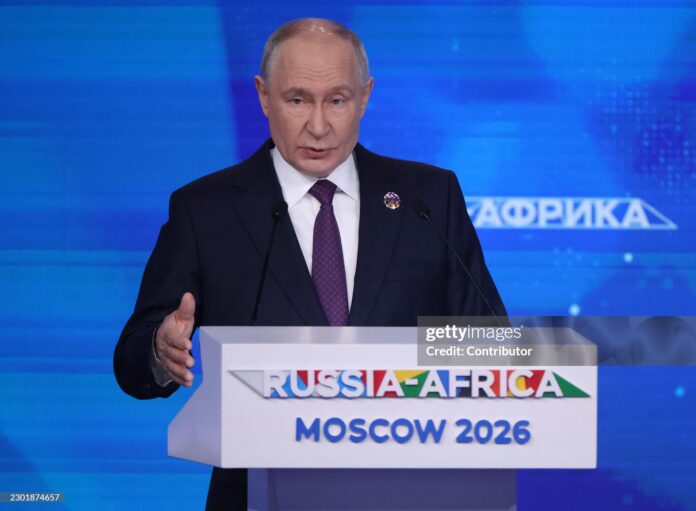

President Vladimir Putin has stepped up Russia’s campaign to deepen its influence across Africa, portraying Moscow as a more dependable development partner than Western powers, which he accused of exploiting the continent’s resources and perpetuating economic dependence through debt.
Addressing the third Russia-Africa Summit in Moscow on Wednesday, Putin presented Russia as an alternative to what he described as the West’s lingering colonial ambitions, arguing that African countries should have greater control over their economic futures and a stronger voice in international affairs.
The two-day gathering has brought together African leaders and government delegations from 48 countries, including 22 heads of state expected to hold bilateral discussions with Putin. Talks are expected to cover trade, security, military cooperation, arms supplies and food security.
First convened in 2019, the summit has become a central instrument of Moscow’s strategy to expand its political, economic and military presence across Africa, a continent increasingly important to Russia’s efforts to counter Western diplomatic pressure over its war in Ukraine.
Russia’s ambitions extend beyond government-to-government relations. Its paramilitary Africa Corps remains active in several African countries, while state-backed media organizations and cultural institutions are seeking wider audiences. Russian companies are also pursuing commercial opportunities in strategic sectors, including mining and electricity generation.
Putin used his address to argue that Africa’s growing geopolitical and economic importance was reshaping the international order, but warned that established Western powers were resisting the emergence of a more multipolar global system.
He accused countries with colonial histories of seeking to preserve their economic advantages and prevent Africa from exercising greater independence in global affairs.
Although he did not identify any Western government by name, Putin alleged that Western financial practices were perpetuating a cycle of indebtedness across the continent. He argued that loans offered on unfavourable conditions could undermine long-term development by leaving African economies financially constrained.
Moscow, he insisted, was offering a different model of engagement, one centred on technology transfers, industrial development and the establishment of local production capacity rather than the extraction of African raw materials.
Putin said Russia was prepared to share technical expertise, particularly in digital technologies, and support manufacturing initiatives that could generate employment, strengthen domestic industries and expand government revenues through taxation.
The Russian president’s appeal comes amid growing competition between Moscow and Western governments for strategic influence in Africa, where security partnerships, access to natural resources and diplomatic alliances have become increasingly contested.
Western governments have accused Russian paramilitary forces of supporting military-led governments, particularly in the Sahel, as part of a broader effort to consolidate Moscow’s influence and displace traditional Western partners, including former colonial power France. Russia has rejected those allegations.
Burkina Faso’s Prime Minister, Rimtalba Jean Emmanuel Ouedraogo, offered a strong endorsement of the relationship, describing cooperation with Moscow as transparent and mutually beneficial.
Speaking to Russian state broadcaster RT, Ouedraogo argued that Russia respected African interests, languages and cultural identities, contrasting its engagement with what he characterized as France’s imperial legacy.
Beyond the political rhetoric, Putin outlined several areas in which Moscow hopes to strengthen its economic ties with African countries. He expressed support for expanding the continent’s representation within the International Monetary Fund and World Bank, institutions in which African governments have long sought greater influence.
He also proposed cooperation on major transport and agricultural infrastructure projects, while reaffirming Russia’s readiness to supply additional African countries with grain and fertilizer.
The food-security offer carries particular significance for African economies vulnerable to international supply disruptions and fluctuations in global commodity markets.
Yet Moscow’s promise of a more equitable partnership will be measured against the practical outcomes of its engagement, including whether Russian investment translates into sustainable industrial capacity, employment and lasting economic benefits for African populations.
For Putin, the summit is about more than commercial opportunities. It is an opportunity to position Russia as an indispensable partner to a continent whose diplomatic support, strategic resources and expanding economic potential have become increasingly valuable in a changing international order.