

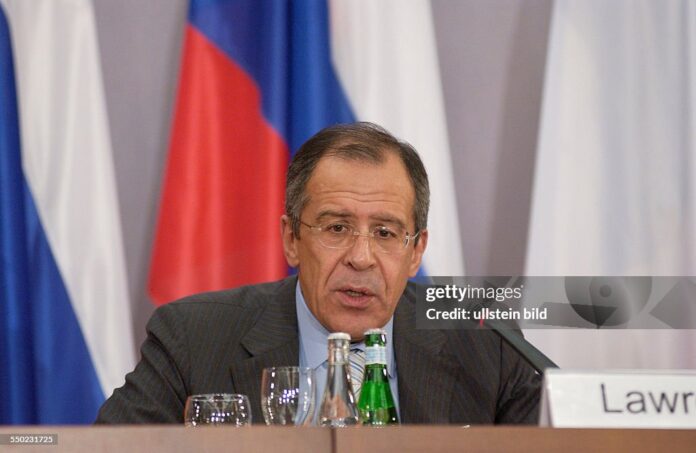

An examination of Moscow’s unchanged position on Ukraine, the limits of Russia’s security claims and the dangerous implications of allowing military aggression to determine another country’s sovereign choices.
There is a legitimate principle beneath Lavrov’s rhetoric: every state has a right to security. Those concerns deserve diplomacy, arms-control negotiations and reciprocal risk reduction. They do not confer a right to determine another sovereign state’s alliances, armed forces or political choices. The United Nations Charter requires peaceful dispute settlement and prohibits force against another state’s territorial integrity or political independence. Article 2(4) contains no exception for a great power that feels strategically uncomfortable. That is the difference between managing a security dilemma and granting a licence to erase a neighbour’s independence.
The chronology undermines Moscow’s claim to be reacting to an imminent Ukrainian military threat. Ukraine was not a NATO member when Russia launched its full-scale invasion in February 2022, and it remains outside the alliance. NATO describes Ukraine as a partner, not a member covered by Article 5. A possible future alignment cannot retrospectively legalize an invasion launched before membership existed. The 2024 NATO position still made an invitation conditional on allied agreement and conditions being met; it did not promise immediate accession.
Nor can the Kremlin credibly present itself as guardian of borders. In 1994, Russia joined the United States and Britain in giving security assurances to Ukraine as Kyiv acceded to the Nuclear Non-Proliferation Treaty and surrendered the Soviet nuclear arsenal on its territory. The Budapest Memorandum reaffirmed respect for Ukraine’s independence, sovereignty and existing borders, and an obligation to refrain from force against it. Russia’s annexation of Crimea in 2014 and full-scale invasion in 2022 shattered that assurance. The memorandum was not a NATO-style automatic military guarantee, but it recorded explicit political commitments to respect Ukraine’s sovereignty and borders.
The Invasion Created the Threat It Invokes
Lavrov’s logic reverses cause and consequence. Ukraine’s military posture did not emerge in a vacuum. Russia seized Crimea and intervened in eastern Ukraine in 2014; it then launched an invasion on 24 February 2022. Kyiv’s drive to strengthen its armed forces, obtain Western weapons and seek security guarantees is an intelligible response to demonstrated aggression. Russia’s military expansion and repeated cross-border operations have also driven neighbouring states to seek stronger protection.
The human cost makes this more than a semantic dispute. The UN Human Rights Monitoring Mission verified at least 15,172 civilian deaths and 41,378 injuries between 24 February 2022 and 31 January 2026. It reported that 2025 was the deadliest year for civilians since 2022, with 2,526 killed and 12,162 injured; 97 per cent of casualties in government-controlled territory were caused by attacks launched by Russian forces. Moscow’s claim to defend security must be measured against the insecurity its war has inflicted on millions.
Military spending exposes another contradiction. SIPRI estimated Russia spent $149 billion on its military in 2024, a 38 per cent increase and 7.1 per cent of GDP. Ukraine spent $64.7 billion, equal to 34 per cent of its GDP, as it fought for survival. NATO members together spent $1.506 trillion, but that aggregate represents 32 sovereign governments, not one offensive force under unified command. These figures show a heavily militarized confrontation, not proof Ukraine was preparing an attack.
The Strongest Russian Argument Still Fails
Moscow’s strongest counterargument is not frivolous: NATO enlargement, Western weapons deliveries and intelligence cooperation have altered the strategic balance around Russia. NATO’s open-door policy and support for Ukraine’s eventual membership contribute to Russian threat perceptions. Arms transfers can prolong fighting, increase escalation risks and complicate diplomacy.
But acknowledging those risks does not validate Russia’s remedy. Ukraine is entitled to defend itself under Article 51 of the UN Charter. A country under attack cannot be expected to remain militarily weak so its aggressor feels comfortable. Nor does indivisible security mean one state’s preferred arrangement overrides another’s sovereignty. If Russia can demand that Ukraine be neutral, disarmed or barred from choosing partners, “security” becomes a euphemism for domination.
Lavrov’s criticism of President Volodymyr Zelenskyy’s comments about weapons and strikes on Russian targets also applies a selective standard. Russia has used missiles and drones against Ukrainian cities and infrastructure throughout the war. Ukrainian attacks on military targets inside Russia raise legitimate questions of proportionality, distinction and escalation; each operation must be judged carefully and individually under international humanitarian law. But demanding that Ukraine renounce the ability to strike back while Russia retains the ability to bombard Ukraine is not a negotiating principle. It is imposed asymmetry.
A Settlement Must Protect Ukraine, Not Reward Aggression
Lavrov’s insistence that Moscow’s position is unchanged is therefore not evidence of diplomatic seriousness. It signals that Russia continues to define peace through conditions imposed on Ukraine, rather than a settlement negotiated between equals. The UN General Assembly’s March 2022 resolution deploring Russia’s aggression passed by 141 votes to five, with 35 abstentions.
Renewed talks can address security without legitimizing conquest. Kyiv has indicated interest in trilateral discussions with Russia and the United States and wants Europe involved. Lavrov’s public rebuke of Ukrainian weapons plans is not a substantive negotiating offer. A credible process requires an agenda, reciprocal commitments, verification, civilian protection and consequences for violations in practice. It cannot begin by treating Ukraine’s self-defence as illegitimate while leaving Russia’s territorial claims untouched.
A durable European settlement could include limits on deployments, missile transparency, incident-prevention channels, monitoring and reciprocal arms-control measures. But arrangements must be voluntary, enforceable and consistent with every state’s sovereignty. Ukraine cannot be asked to exchange independence for a promise that invasion will pause until Moscow is ready to resume it.
Whether Russia has security interests is not in question. The question is whether those interests grant it ownership of Ukraine’s strategic future. They do not. Lavrov’s formula mistakes coercion for security and silence for peace. A settlement rewarding that logic would not end the war’s causes; it would institutionalize them and invite future aggression across Europe. Peace must make Ukraine materially and sustainably safer from Russia, not make Russia safer from a sovereign Ukraine.