

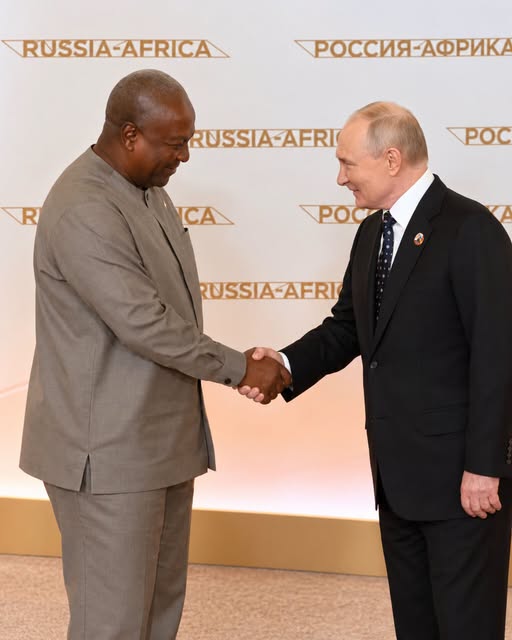

Mahama and Putin move to reset bilateral ties, advancing a 2,000MW nuclear project, military cooperation and agricultural investment.
Ghana and Russia are moving to forge a more consequential strategic partnership, with President John Dramani Mahama and Russian President Vladimir Putin agreeing on major initiatives spanning nuclear power, defence, agriculture, education and security.
The most significant commitment is a proposed 2,000-megawatt nuclear power plant, an ambitious project aimed at strengthening Ghana’s energy security, powering industrial expansion and reviving a vision championed by the country’s first President, Dr. Kwame Nkrumah, before his overthrow in the 1966 coup.
The agreements, reached during high-level talks at the Kremlin last Friday following the 3rd Russia-Africa Summit, signal a deliberate shift from decades of diplomatic friendship towards practical economic cooperation and strategic engagement.
Alongside nuclear energy, the two countries have committed to a new defence agreement to facilitate the acquisition of strategic military assets for the Ghana Armed Forces. They will also deepen agricultural cooperation to increase grain production and improve fertilizer supplies, expand scholarship opportunities for Ghanaian students and strengthen military and institutional capacity.
In a significant security development, Putin declared that Ghanaians would no longer be allowed to participate in the war in Ukraine, whether through voluntary enlistment or irregular recruitment.
The two governments have also agreed to revive the Permanent Joint Commission for Cooperation, providing an institutional mechanism to drive implementation of their commitments. Moscow has expressed readiness to host the next meeting within the coming weeks.
Addressing Putin, Mahama argued that Ghana’s economic standing and improving investment environment made the country an attractive partner for Russian capital and enterprise.
He cited Ghana’s position as Africa’s eighth-largest economy, with an estimated GDP of $120 billion and annual growth of approximately six per cent, as evidence of the opportunities available to both countries.
Mahama said the relationship had reached a point where diplomatic goodwill must translate into investments, commercial partnerships and measurable development gains.
He identified energy, agriculture, trade, infrastructure, education, healthcare, science and technology as critical areas for expanding bilateral engagement, describing the Russia-Africa Summit as an important platform for opening a new chapter in economic relations.
He also underscored the importance of restoring the Permanent Joint Commission, indicating that Ghana intended to convene the next meeting the following year to establish a structured framework for advancing cooperation.
The President grounded his appeal for stronger relations in the historical ties between the two countries, recalling Moscow’s support for African liberation movements and the struggle against apartheid.
He also pointed to Russia’s provision of Sputnik V vaccines during the COVID-19 pandemic as evidence of its solidarity with Africa during a period of unprecedented public health challenges.
Ghana and Russia established diplomatic relations in 1958, following Ghana’s independence in 1957. Mahama recalled Nkrumah’s landmark 1961 visit to Russia, where he met Nikita Khrushchev, then First Secretary of the Communist Party of the Soviet Union. The visit marked an important chapter in relations between Moscow and the newly independent African state.
Putin, for his part, reaffirmed Russia’s commitment to strengthening the relationship, singling out education, military development and public-sector capacity building for particular attention.
He identified opportunities for Russian support in training Ghanaian students, enhancing the capabilities of the Ghana Armed Forces and developing the professional skills of Ghana’s civil service.
The Russian leader also reported a six per cent increase in bilateral trade between January and August, describing the performance as encouraging and among the strongest recorded in sub-Saharan Africa.
He further acknowledged Ghana’s support for Russian-sponsored resolutions at the United Nations, highlighting the diplomatic cooperation underpinning the relationship.
The agreements mark an important attempt to convert a longstanding political partnership into a strategic economic relationship with direct implications for Ghana’s development.
The proposed nuclear power project is particularly significant. Beyond its potential contribution to electricity generation, it revives an ambitious national aspiration associated with Nkrumah and places nuclear energy back at the centre of Ghana’s industrialization ambitions.
The defence, agricultural and educational commitments similarly point to a broader partnership extending into national security, food production and skills development.
But the real test will be execution. Financing, technical feasibility, regulatory requirements and clearly defined implementation timelines will determine whether the Moscow commitments become transformative projects or remain diplomatic declarations.
For Mahama, the challenge is to secure tangible economic and strategic returns from Ghana’s renewed engagement with Moscow. For Putin, the partnership offers an opportunity to deepen Russia’s economic and diplomatic presence in West Africa.
Both governments have signalled their intentions. The priority now is to turn the Kremlin agreements into concrete results for Ghana and its people.