

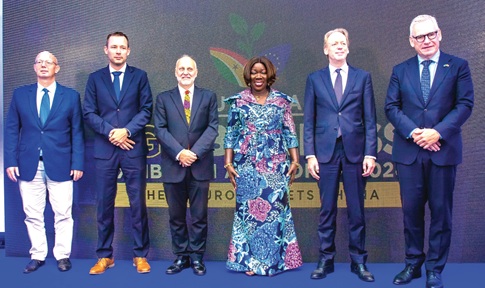

Ghana is stepping up efforts to attract European investment into agricultural processing, with 30 local agribusiness companies showcasing their products and pursuing export partnerships at a major trade mission in Accra.
The companies, selected from nearly 100 applicants, featured at the two-day EU-Ghana Agribusiness Exhibition Forum and Trade Mission 2026, which attracted 42 exhibitors and more than 650 registered visitors.
Held under the theme Where Europe Meets Ghana, the event brought together investors, policymakers, farmers, processors, exporters and technology providers to forge partnerships, unlock financing and expand trade opportunities across the agricultural value chain.
At the centre of the discussions was Ghana’s ambition to move beyond exporting raw agricultural commodities and build a competitive processing industry that retains more value, creates jobs and boosts export earnings.
The Minister of Trade, Agribusiness and Industry, Elizabeth Ofosu-Adjare, called on European investors to move beyond conventional buyer-seller relationships and commit capital to joint ventures, processing facilities and supplier-development programmes.
At the opening ceremony, held under the theme “Driving Real Investment, Innovation and Sustainable Agribusiness” in Ghana, she said the government was pursuing an aggressive value-addition agenda anchored on domestic processing, industrial parks and strategic international partnerships.
She cited the volatility of global cocoa prices as evidence of the dangers of depending on raw commodity exports, noting that prices had fallen from approximately $10,000 per tonne in early 2025 to about $4,000 in early 2026.
The minister said Ghana’s response was to expand domestic processing and reduce its exposure to fluctuations in international commodity markets.
She disclosed that the government was targeting domestic processing of at least 50 per cent of the country’s cocoa production, supported by installed grinding capacity exceeding 500,000 metric tonnes.
Mrs. Ofosu-Adjare said the policy direction was irreversible, with opportunities extending beyond cocoa to cashew, cassava, maize, rice, fruits and vegetables, oil palm and shea.
She urged local businesses to identify the financing, technology and market connections needed to scale up production, while challenging European companies to invest in Ghana’s productive capacity rather than limit their involvement to commodity purchases.
The Executive Director of the European Chamber of Commerce in Ghana (EUROCHAM), Nicolas J. Gebara, called for stronger European business participation in the country’s agribusiness transformation.
He identified technology, technical expertise, investment, financing and access to European markets as critical contributions European companies could make to strengthening Ghana’s agricultural sector.
Mr. Gebara said the strong response from businesses demonstrated growing interest in Ghana’s agribusiness opportunities, adding that the forum’s panel discussions and masterclasses were designed to address the practical challenges confronting farmers, entrepreneurs and industrialists.
He also pointed to the EU-Ghana Economic Partnership Agreement (EPA) as a significant trade advantage, offering eligible Ghanaian products duty-free, quota-free access to the European market.
The European Union Ambassador to Ghana, Rune Skinnebach, reaffirmed the EU’s commitment to supporting the country’s agricultural transformation through investment, technology transfer and technical expertise.
He stressed that Ghana must strengthen processing, storage, cold-chain infrastructure, packaging and branding if its agricultural products were to command greater value in international markets.
However, he warned that exporters must meet European standards on food safety, quality and traceability to fully exploit the opportunities under the EPA.
Adding a concrete investment commitment to the discussions, the Vice-President and Head of West Africa at AAK, Lasse Skaksen, reaffirmed the company’s plans to establish a manufacturing facility in Tema.
The proposed facility is expected to expand local processing capacity and strengthen the competitiveness of Ghanaian shea products, supporting the country’s broader ambition to transform agricultural commodities into higher-value exports.