

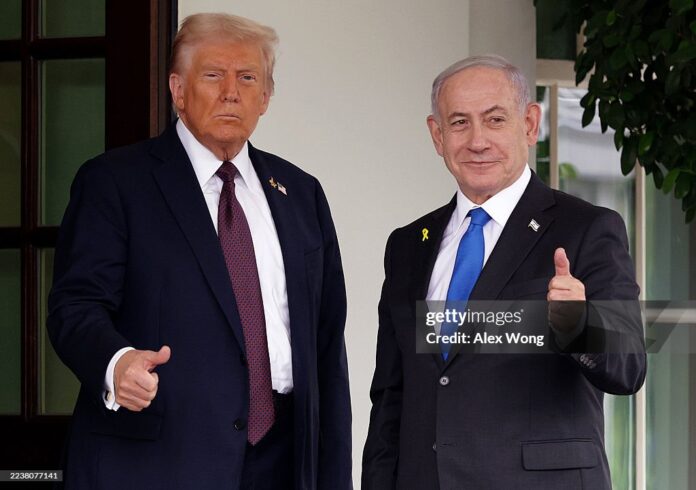

Washington is treating military aid to Israel as a bill it can simply stop paying. President Donald Trump’s announcement that the United States will end roughly $4 billion in military assistance by the end of 2026 is not merely a saving for American taxpayers; it risks dismantling a system of influence, interoperability and technological cooperation that has served both countries. Former Israeli ambassador Michael Oren’s warning is less about the money than the speed and terms of the divorce.
Trump said he and Prime Minister Benjamin Netanyahu had agreed months ago to terminate the payments, arguing Israel is prosperous enough to manage without them and that aid has become a political liability for Republicans. The announcement lacked operational detail. Nor can a president casually erase congressional appropriations and a bilateral framework authorized through 2028. The 2016 memorandum of understanding commits Washington, subject to congressional appropriation, to $38 billion over fiscal years 2019-2028: $33 billion in Foreign Military Financing and $5 billion for missile defence.
Oren told Israeli radio on November 3 that Israel had been speaking as if it had another decade to move from aid to partnership, but “this is not our timetable, it is theirs”. He called Trump’s announcement either a “trial balloon or a bombshell” and questioned an immediate cutoff during wartime. His objection is not independence; it is an abrupt transition imposed by American domestic politics before Israel has secured replacement arrangements.
Israel’s Security Arithmetic Changes Overnight
The annual $3.3 billion in military financing is substantial, but its significance is structural. It enables multi-year purchases of aircraft, munitions, helicopters and other advanced systems while preserving access to American supply chains, training and upgrades. The additional $500 million annually supports joint missile-defence programmes, including Iron Dome, David’s Sling and the Arrow family. This distinction matters because the $3.3 billion grant is not a cheque for unrestricted spending: it is a financing mechanism tied to American defence purchases, while the missile-defence allocation funds shared programmes. The 2024 supplemental package and wartime resupply also demonstrated that access to US stocks and political decisions can matter as much as the annual baseline. Israel’s independence therefore requires not only money, but reliable industrial capacity, inventories and assured access to critical components.
Since fiscal 2009, Washington has provided $3.4 billion for Israeli missile defence, including $1.3 billion for Iron Dome from 2011, according to the State Department. Israel is wealthy, technologically sophisticated and a major arms producer. Its defence exports reached a record $14.8 billion in 2024, up 13 per cent; missile, rocket and air-defence systems accounted for 48 per cent of export deals. Domestic production cannot quickly replace every American-made aircraft component, precision munition, engine, spare part or maintenance pipeline. Israel operates US-origin F-35s and F-16s; keeping them combat-ready requires parts, software, technical support and approved upgrades.
The shock would arrive amid high operational demand. Israel faces threats from Hamas, Hezbollah, Iran and armed groups across the region. A sudden $3.3 billion annual gap would force difficult choices, even in a strong economy. Missile defence is especially sensitive: these systems are jointly developed and produced, not simply bought off a shelf. Ending US contributions without a successor could slow production, raise costs and weaken replenishment after sustained interceptions.
What America Stands to Lose
The United States does not give Israel money in a one-way act of generosity. Much of the financing returns to American manufacturers because Foreign Military Financing is used largely to buy US defence equipment. Missile-defence cooperation is directly reciprocal. Congressional Research Service reporting says at least half of annual procurement and co-production funds must be spent in the United States. With roughly $200 million allocated to procurement and co-production, at least $100 million annually is spent domestically. A cutoff could mean lost orders and less predictable demand.
Washington also risks losing privileged access to Israeli battlefield experience and innovation. Joint work on Iron Dome, David’s Sling and Arrow has advanced American understanding of interception, sensors, tracking and integrated air defence. Israel’s operational environment generates lessons about drones, rockets, electronic warfare and layered attacks relevant to US forces and allies. Ending aid would not automatically end cooperation; it could weaken trust and expose collaboration to political disputes.
There is a geopolitical cost. Israel provides intelligence on Iran and regional armed networks and remains a capable partner in a strategically important theatre. Oren called American diplomatic support Israel’s “political and diplomatic Iron Dome” at the United Nations. Washington’s influence, intelligence coordination and diplomatic protection reinforce one another. If aid ends without a broader partnership, other governments may conclude that US security commitments are transactional and reversible. Allies in the Gulf, Europe and Asia will ask what political conditions might suddenly attach to their own defence relationships.
Independence Requires a Bridge, Not a Cliff
Israel’s economy and defence industry have matured; US domestic support has become more contested; and Oren argues that aid can constrain Israeli procurement choices. He has cited Washington’s refusal to approve certain platforms and weapons Israel wanted, while US restrictions have also limited Israeli defence dealings with China.
But transition must be negotiated, phased and specific. The governments should distinguish direct financing from joint missile-defence research, co-production, intelligence sharing, emergency resupply and commercial arms sales. Congress must participate: the current MOU runs through September 2028, and Trump’s announcement alone does not settle the legal or budgetary mechanics.
The choice is not between permanent dependency and instant independence. It is between an orderly evolution that preserves mutual advantage and a rupture that leaves both sides poorer in security, influence and industrial opportunity. America should not confuse ending a subsidy with ending the value of an alliance. If Washington wants a stronger, more self-reliant partner, it should build the bridge to that future, not blow it up.