

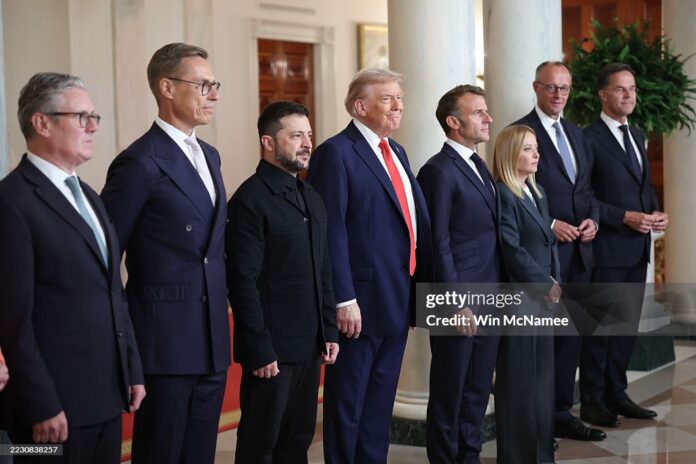

Abu Dhabi is not merely a peace meeting. It is a test of who gets to shape Europe’s security. Europe cannot outsource its security and then accept the bill for decisions made without it. That is the blunt reality behind the European presence at the Ukraine talks in Abu Dhabi on November 10-11. French Foreign Minister Jean-Noël Barrot confirmed on November 8 that European representatives, including France, would participate. Any settlement affecting Europe’s balance of power requires European consent, capabilities and money.
If negotiations determine Ukraine’s future military posture, territorial arrangements, sanctions, reconstruction and the deployment of foreign forces, they will also determine Europe’s exposure to Russian power long-term. A bargain struck over European heads could weaken NATO’s credibility, fracture the European Union and reward coercion. Participation is a matter of continental security.
The Stake Is Not Ukraine Alone
Europe’s material stake is overwhelming. The European Commission says total EU support for Ukraine has reached €235.9 billion, including €77.9 billion in military assistance and €121.7 billion provided or guaranteed through the EU budget. The European Defence Agency reports that the 27 member states spent €418 billion on defence in 2025, around 2.2 per cent of GDP, with spending projected at €454 billion in 2026. Europe finances Ukraine’s resistance and expands its own defences, yet risks limited influence over the settlement.
The EU accounted for about 65 per cent of Ukraine’s goods trade in 2025; bilateral goods trade reached €68.2 billion. The World Bank, European Commission, United Nations and Ukrainian government estimate recovery and reconstruction needs at $587.7 billion over ten years, almost three times Ukraine’s 2025 GDP. Europe will be a major financier, market, host and security provider; it cannot assume these obligations without a voice.
Russia’s invasion has challenged the principle that borders cannot be changed by force. If Moscow secures strategic gains through prolonged aggression, governments elsewhere will study the precedent. A settlement that freezes conquest without credible safeguards could turn a temporary pause into a dangerous model.
The Geopolitical Imperatives
Europe’s first imperative is to ensure that Ukraine, not Washington, Moscow or Brussels, retains agency over its own future. Kyiv must not be pressured into accepting territorial concessions or limits on its armed forces as the price of an immediate ceasefire. Any agreement must be consistent with Ukraine’s sovereignty and include verifiable monitoring, clear consequences for violations and the means to defend itself. Security guarantees that depend on political goodwill alone are not guarantees.
The second imperative is unity. Europe is not a single diplomatic actor: France, Germany, Britain, Poland, the Baltic states and others have different threat perceptions, military capacities and domestic constraints. EU foreign policy decisions often require unanimity, while NATO operates through consensus among allies. Italian Prime Minister Giorgia Meloni has raised the question of who can speak for the EU; European Council President António Costa has backed discussion of a common approach. Without coordination, Moscow and Washington can exploit divisions.
Moreover, Europe must connect Ukraine’s guarantees to its own defence. NATO remains the foundation of collective defence for its members; Ukraine’s future arrangements must not create ambiguity about Article 5 or weaken the alliance’s eastern flank. The EU and NATO should coordinate military aid, intelligence, air defence, ammunition production, training and any monitoring mission. NATO reported that European allies and Canada spent $574 billion on defence in 2025, 2.33 per cent of combined GDP, and had increased real spending by 20 per cent from 2024. Spending must produce capability and resolve.
Washington’s emerging proposal for a broader European security framework adds another layer. US envoy Jared Kushner has outlined permanent consultations, crisis communications, military transparency, reciprocal risk-reduction measures and a long-term stability arrangement. But a framework that treats Russia’s demands as equivalent to the sovereign choices of neighbouring states would institutionalize a Russian veto over Europe’s security order. Dialogue is useful; spheres of influence are unacceptable.
The diplomatic choreography matters. Abu Dhabi offers a venue outside Europe, potentially useful for discreet bargaining and for the UAE’s role as an interlocutor. But geography must not obscure the substance: European states face consequences, from force deployments and refugee movements to energy infrastructure and renewed escalation. Their participation must extend beyond an observer role. They need access to negotiating texts, places in working groups and a formal mechanism to approve provisions imposing obligations on them.
Europe must resist the false choice between negotiating and supporting Ukraine militarily. Diplomacy is most effective when backed by credible capacity. Continued assistance gives Kyiv options; predictable European commitments reduce incentives for Moscow to wait out Western unity. Conversely, aid should serve a clear objective: a sovereign Ukraine able to deter another attack, not an indefinite war without strategy. Balancing pressure and negotiation will be difficult, but abandoning either would be reckless. That is essential to preserve Europe’s strategic independence.
Abu Dhabi’s Test
Russia has historically resisted European involvement in direct negotiations, while the United States is driving the process. Moscow’s announced delegation includes senior diplomatic and military figures, a signal that it intends to discuss both political and military questions. Europe needs a common position, commitments and leverage.
Europe controls major sanctions instruments, provides financial support, supplies weapons and training, and will shape reconstruction and Ukraine’s path towards EU membership. Sanctions relief must be phased, conditional and reversible; reconstruction funding must follow security and governance benchmarks; and any ceasefire monitoring must have access, verification powers and agreed responses to breaches. European states should also define in advance what forces, logistics, air defence or financial guarantees they are prepared to provide and what parliamentary approvals those commitments require.
Abu Dhabi will not resolve the war in two days. It can test whether diplomacy can move beyond pauses towards a durable settlement. Europe should neither sabotage negotiations nor bless an agreement simply because it is called peace. It must insist that Ukraine’s consent, credible deterrence and European security are inseparable. A seat at the table is the minimum. The responsibility is to shape what comes after.