

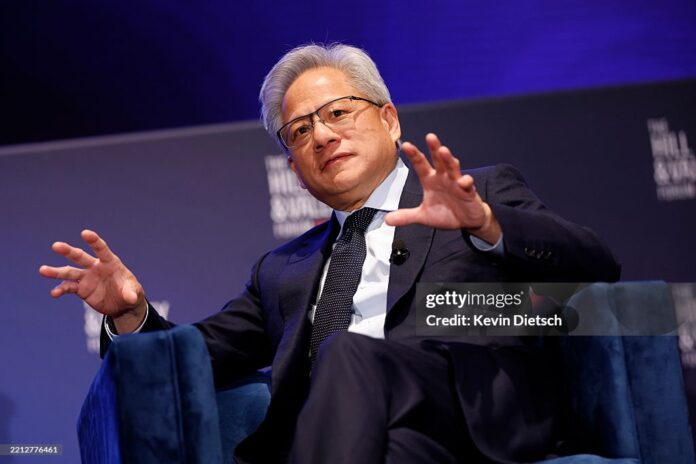

A growing revolt is gathering momentum at Nvidia, with more than 170,000 people, including thousands of company employees, senior technology executives and billionaire Elon Musk, backing a campaign to bring co-founder Jensen Huang back as chief executive after his abrupt departure triggered turmoil at the chipmaking giant.
The petition’s organizers contend that Huang was pushed out without being given a meaningful opportunity to defend himself, raising questions about the circumstances surrounding his sudden exit from the company he spent more than three decades building.
Huang resigned on Thursday following an investigation into his extramarital relationship with a woman suspected by US intelligence agencies of spying for China. The relationship became public just days before his departure, setting off a leadership crisis at one of the world’s most influential technology companies.
In response, Nvidia appointed Chief Financial Officer Colette Kress as interim CEO and announced plans to recruit a permanent successor. The uncertainty has rattled investors, with the company’s market capitalization shrinking by more than $500 billion over the past week.
The campaign to reinstate Huang has attracted significant support from within Nvidia itself. According to the petition’s website, more than 8,800 employees have signed, representing approximately one-fifth of the company’s workforce.
Among the prominent supporters are Epic Games chief executive Tim Sweeney, Shopify CEO Tobias Lütke and Musk, who publicly endorsed the initiative on Friday, declaring his support for Huang’s return.
The organizers, describing the effort as an independent, volunteer-led campaign with no formal connection to Nvidia or Huang, argue that his extraordinary contribution to the company warrants a fair hearing before any permanent leadership decision is made.
Their central argument is that Huang’s 33-year record of building Nvidia from an ambitious semiconductor venture into a global technology powerhouse should not be overshadowed by the controversy surrounding his personal life. They maintain that his departure deserves greater scrutiny, particularly given the speed with which events unfolded.
Meanwhile, the possibility of Huang returning to the company has gained fresh attention after the Financial Times reported on Sunday that he was discussing a potential comeback with allies.
However, Wall Street analysts remain deeply skeptical that the campaign will succeed.
The political pressure surrounding Nvidia’s leadership has further complicated the prospect of Huang’s reinstatement. Treasury Secretary Scott Bessent said Sunday that the company should consider an external candidate, suggesting that a change at the top could help address mounting concerns over its business practices and oversight.
Bessent’s comments came amid questions about whether Nvidia’s chip sales to businesses in Singapore and other Asian markets had been used to circumvent US export restrictions, potentially allowing advanced technology to reach China through intermediary companies.
He questioned whether Nvidia had adequately responded to warning signs involving suspected shell companies, particularly those operating in Singapore.
The administration’s scrutiny of the company’s export-control compliance, combined with Bessent’s preference for an outsider to take charge, has weakened expectations of Huang’s return.
Vital Knowledge analyst Adam Crisafulli told investors that the likelihood of Huang being reinstated appeared remote, pointing to the growing pressure for a fundamental change in Nvidia’s leadership.
Investors are also bracing for further volatility in the company’s shares. Nvidia stock fell $5.30 or 3.3%, to $157.55 in premarket trading on Monday, extending a difficult period for shareholders.
Attention is now shifting to Tuesday afternoon’s earnings call, where investors will be looking for reassurance about the company’s growth prospects and whether its management team can maintain confidence in its financial outlook despite the leadership upheaval.
One of the most consequential issues will be Nvidia’s previously indicated expectation of 70% sales growth in the next fiscal year. Investors want to know whether the company will stand by that projection or revise its outlook in response to uncertainty surrounding US export restrictions and the implications of Huang’s departure.
For Nvidia, the immediate challenge extends beyond finding a successor. The company must convince investors that its growth trajectory, strategic direction and ability to navigate intensifying geopolitical scrutiny remain intact, even as an unprecedented leadership battle threatens to overshadow its business.