

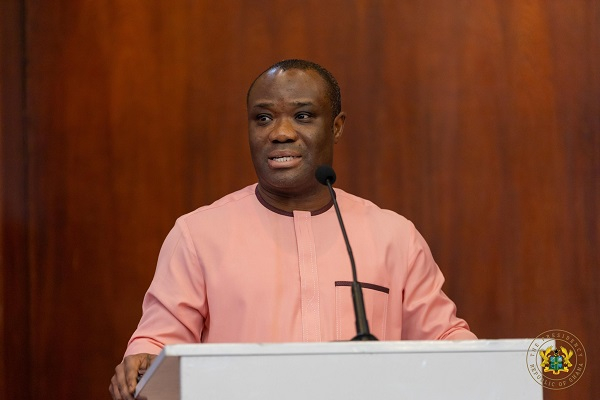

The government’s appeal to national security should not come at the expense of transparency and public accountability. Felix Kwakye Ofosu’s latest explanation does not settle the controversy. It deepens it. On November 17, 2026, the Presidential Spokesperson and Minister of Government Communications claimed that the Falcon 6X formed part of a broader military retooling programme initiated following an urgent request by the Ghana Air Force (GAF).
According to him, the military requested six aircraft, comprising four helicopters and two executive jets, following the August 6, 2025 helicopter disaster. This explanation deserves considerably more scrutiny than the government’s communications machinery appears willing to tolerate. National security is not a magic phrase that transforms every questionable expenditure into an unquestionable strategic necessity.
The fundamental issue is not whether Ghana needs a modernized Air Force. It unquestionably does. The question is whether the government has demonstrated, with credible operational evidence, that purchasing an executive aircraft costing US$60.68 million was the appropriate response to the military’s most pressing capability deficiencies. Kwakye Ofosu has offered a political defence, not a sufficiently transparent military justification.
The Parliamentary Record Exposes the Contradictions
The Defence and Interior Committee’s report confirms that Parliament received two procurement agreements on December 3, 2025: a €125,965,974 contract with Airbus Helicopters for one H160 and three H175 helicopters, and a US$60,680,000 agreement with Dassault Aviation for one Falcon 6X. These are five aircraft, not six. More importantly, the parliamentary documentation identifies the Falcon 6X as an acquisition for the Ghana Air Force, but does not independently establish Kwakye Ofosu’s assertion that the original Air Force request specifically demanded two executive jets.
That distinction matters. A minister’s retrospective account of Cabinet deliberations is not a substitute for the original military memorandum, its technical specifications, operational assessment and cost-benefit analysis. The published budget must be read alongside the signed contracts, not selectively invoked after public criticism. Under the Ghana Armed Forces retooling programme, it stated that procurement processes would begin in 2026 for four modern helicopters, one long-range aircraft and one medium-range aircraft. It anticipated delivery within four years, provided procurement processes were completed in 2026.
Where, then, does the already contracted Falcon 6X fit into this chronology? Why was an aircraft agreement presented to Parliament in December 2025 while the budget, published weeks earlier, described a future procurement process for long-range and medium-range aircraft? These documents raise legitimate questions about sequencing, planning and the government’s presentation of its acquisition programme. They demand an explanation, not political theatrics. The public is entitled to know which plan then governed the actual purchase.
The Real Military Crisis and the Cost of the Jet
The government’s own parliamentary report provides compelling evidence of genuine Air Force distress. It records that the Falcon 900EX, in service since 2010, had developed serious defects, including corrosion and fuel leakage, while sourcing spare parts had become difficult because the model was no longer in production. All six Mi-17 helicopters were unserviceable. All four Z-9EH helicopters were also unserviceable, with one lost in the August 2025 accident. Of three CASA C295M aircraft, only one was serviceable.
A military with ten unserviceable helicopters and only one serviceable aircraft of the CASA type needs a coherent recovery plan, transparent priorities and measurable readiness targets. The government must explain why an executive jet ranked alongside transport helicopters and operational platforms, and how its acquisition improves the Air Force’s ability to conduct troop movement, medical evacuation, surveillance, logistics and emergency response. The Falcon 6X has a stated maximum range of 5,500 nautical miles, approximately 10,186 kilometres. That is an impressive capability for long-distance strategic transport. But range alone does not make an aircraft a combat asset. The public deserves clarity on its assigned missions, passenger configuration, deployment rules, annual operating costs, maintenance arrangements and expected utilization.
The financial scale also demands accountability. The Falcon contract is US$60.68 million. The four Airbus helicopters cost €125.97 million. Ghana Fact’s published conversion put the combined value at approximately GH¢2.4 billion, although exchange rates and payment dates affect the cedi equivalent. This is public money committed amid competing demands for hospitals, schools, roads and basic services. The issue is not that defence should be starved of funding; it is that defence spending must be justified against clearly ranked threats and capabilities.
National Security Is Not a Licence to Mislead
Kwakye Ofosu’s argument also invites an uncomfortable political comparison. In 2021, John Mahama criticized the previous administration’s use of expensive chartered aircraft, arguing that Ghana already possessed a presidential aircraft capable of international travel. Now, his government must explain why a new executive jet is essential, particularly when the existing Falcon 900 was reportedly assessed as being in good condition after returning from maintenance in November 2025. The committee report, however, records significant defects. These conflicting accounts require technical clarification, not selective quotation.
The strongest conclusion is therefore not that every element of the retooling explanation is demonstrably fabricated. The parliamentary record confirms a wider aircraft procurement, and the Air Force’s documented deficiencies are real. What remains unproven is the claim that the Falcon purchase, in its precise form and timing, was directly demanded by the military as an urgent operational priority. Calling that claim a blatant lie may express legitimate public anger, but proving deliberate deception requires the original Cabinet memorandum and procurement records.
The government should publish the Air Force request, the Cabinet decision, the full contract, the technical evaluation, lifecycle cost estimates and the operational justification for selecting the Falcon 6X. It should also reconcile the December 2025 contracts with the 2026 Budget’s stated procurement timetable. Parliament must scrutinize delivery milestones and ensure that the helicopters and other promised platforms arrive as scheduled.
Ghana needs a capable Air Force, not a communications campaign dressed up as defence policy. Kwakye Ofosu cannot expect citizens to confuse a legitimate military modernization programme with unquestionable approval of every item purchased under its banner. The burden of proof belongs to the government. Until it produces the documents and answers the contradictions, its explanation remains an exercise in political damage control, not a convincing national security case.