

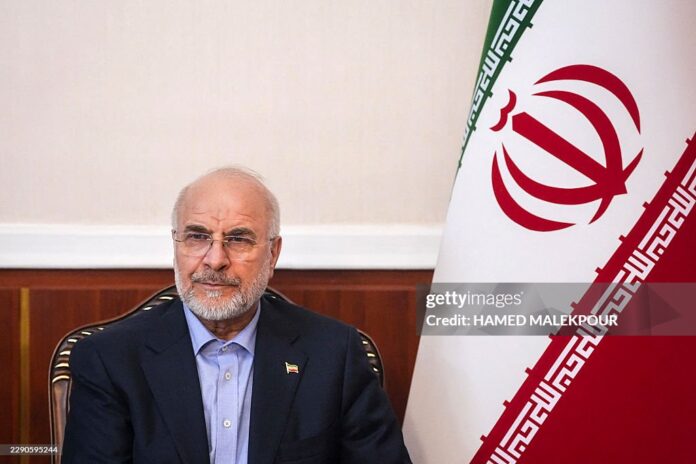

Iranian parliamentary speaker Mohammad Bagher Ghalibaf has seized on a New York Times investigation into the country’s dam construction programme to warn that Washington and Tel Aviv could use allegations of military links to justify attacks on critical civilian infrastructure.
Ghalibaf drew attention to the report on Tuesday, sharing an article examining whether Iran’s expanding network of dams and water-transfer projects could have been designed, in part, to support underground military installations and missile facilities.
The investigation, authored by Sanam Mahoozi and Erika Solomon, explored the possible overlap between major water infrastructure projects and military sites, raising questions about whether some of the developments served purposes beyond civilian water management.
Though the journalists presented no conclusive evidence establishing a direct military connection, the findings have triggered a wider debate over the potential implications for Iran’s civilian infrastructure amid fears of renewed military confrontation.
Ghalibaf, a senior figure in Iran’s political establishment who survived earlier rounds of strikes this year, portrayed the report as an indication that the United States and Israel could broaden their definition of legitimate military targets to include essential civilian facilities.
In a pointed response, he argued that Washington and Tel Aviv could apply the same reasoning to infrastructure situated near their own military installations, suggesting that dams, ports and power stations could equally be classified as dual-use facilities under such logic.
The controversy has since attracted criticism from analysts and experts, many of whom have questioned whether the geographical proximity of dams to military installations provides sufficient grounds to establish a military purpose.
Esfandyar Batmanghelidj, founder and chief executive of the Bourse & Bazaar Foundation, challenged the suggestion that Iran’s extensive dam network was primarily developed to sustain military operations.
He pointed out that fewer than 50 of Iran’s more than 500 large dams are equipped with turbines for electricity generation, arguing that the figures undermine claims that hundreds of dams were constructed to supply power to military facilities.
Batmanghelidj instead attributed the country’s extensive dam-building programme to entrenched economic interests, including construction companies affiliated with the Islamic Revolutionary Guard Corps (IRGC), which he said benefit from infrastructure spending.
He maintained that the proliferation of dams was not unique to Iran, noting that countries such as China had also undertaken large-scale dam construction, including projects whose economic necessity has been questioned.
He further cautioned against interpreting the concentration of military sites and dams in the same geographical areas as evidence of a coordinated military infrastructure strategy. Both are frequently situated in mountainous terrain, he argued, making their geographical overlap an insufficient basis for establishing a direct connection.
Middle East national security and intelligence specialist Danny (Dennis) Citrinowicz offered a different perspective on Iran’s broader military preparedness, pointing to Tehran’s substantial investment in underground facilities, operational redundancy and decentralized infrastructure.
He argued that Iran may have developed independent water and electricity capabilities to preserve the functionality of its missile operations even when civilian infrastructure comes under attack.
In a separate assessment, Citrinowicz said the possibility that water projects were designed to support underground military facilities could fit within Iran’s established strategic approach, although he stressed that the direct relationship between the two remains unproven.
Mohammad Ali Shabani, editor of Amwaj Media, also raised concerns about the implications of the investigation, warning that presenting civilian infrastructure through a military lens could help build public acceptance for attacks on dams and other essential water facilities.
Academic expert Nima Shokri, chair of Geo-Hydroinformatics at the Hamburg University of Technology, similarly cautioned against drawing conclusions from the proximity of dams to military targets.
He argued that geographical overlap does not establish the original purpose of infrastructure projects and cannot, by itself, provide justification for military strikes against them.
Sina Toossi, a senior non-resident fellow at the Center for International Policy, also questioned the strength of the allegations, maintaining that the investigation had not demonstrated that specific Iranian dams were constructed for military purposes.
He emphasized that many of the country’s dams perform essential civilian functions, including supplying water, supporting agricultural irrigation and generating electricity.
The dispute has therefore exposed a central tension surrounding Iran’s infrastructure network: while questions persist over whether some civilian projects may also serve strategic military requirements, analysts caution that speculation and geographical proximity should not be mistaken for proof of military intent.
With the possibility of renewed confrontation hanging over the region, the debate also raises broader concerns about the vulnerability of essential civilian infrastructure and the consequences of expanding the definition of military-linked targets.