

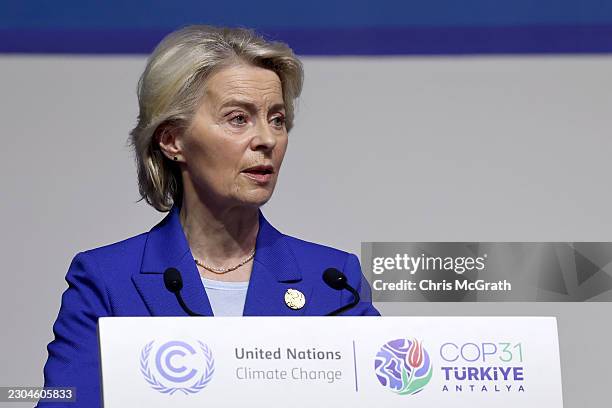

A bitter confrontation over fossil fuels, climate financing and the future of global energy transition has plunged COP31 into failure, after the European Union and other countries rejected a proposed final agreement as inadequate to confront the escalating climate crisis.
The collapse, announced on Sunday after more than two weeks of negotiations, exposed the widening gulf between wealthy economies, developing nations and major oil-producing countries over how quickly the world must abandon fossil fuels and who should pay for the consequences of global warming.
Despite two additional days of negotiations beyond the scheduled closing date, delegates failed to secure consensus on a political declaration, delivering one of the most significant setbacks to international climate diplomacy since the Copenhagen summit collapsed in 2009.
Turkey’s COP31 president, Murat Kurum, declined to present another revised negotiating document, effectively bringing the negotiations to an end while several national delegations were still delivering their closing statements.
The breakdown underscored the growing difficulty of securing meaningful international cooperation as governments grapple with competing pressures, including geopolitical conflicts, economic instability and the increasingly destructive effects of climate change.
Heatwaves, wildfires, devastating floods and intensifying storms are placing mounting pressure on governments, yet the Antalya negotiations demonstrated that international agreement on the underlying causes of the crisis remains deeply contested.
Australia’s COP31 negotiations president, Chris Bowen, described the outcome as deeply disappointing, identifying disagreements over fossil fuels and climate financing as major obstacles that ultimately prevented an agreement.
UN Secretary-General Antonio Guterres also expressed profound disappointment, warning that governments had failed to demonstrate the political determination demanded by the climate emergency.
The failure is particularly consequential because the annual Conference of the Parties remains the principal international mechanism for coordinating climate action, establishing collective ambitions and mobilizing financial support for countries confronting the consequences of rising temperatures.
Yet the setback does not erase previous commitments, including those established under the 2015 Paris Agreement.
That agreement established an ambition to limit global warming to 1.5 degrees Celsius above pre-industrial levels. At the time, existing government policies placed the world on a trajectory towards approximately 4 degrees Celsius of warming by the end of the century. A decade later, projections have improved to around 2.8 degrees, although the outlook remains far beyond the internationally agreed threshold.
This year’s negotiations also took place against an increasingly alarming scientific backdrop. The United Nations’ environmental assessment published in October confirmed that global temperatures were expected to exceed the 1.5-degree threshold, beyond which scientists warn that the severity and frequency of extreme weather impacts will intensify.
Fossil Fuels Emerge as the Defining Battle
At the centre of the diplomatic breakdown was the question of whether the final agreement should explicitly acknowledge fossil fuels as the principal drivers of global warming and establish a clearer pathway towards reducing their use.
The European Union refused to endorse the proposed declaration, arguing that its failure to mention fossil fuels represented a fundamental weakness in any agreement claiming to advance climate action.
Ireland’s Environment Minister, Darragh O’Brien, maintained that an international climate agreement without an explicit commitment to transitioning away from fossil fuels would undermine the credibility of the entire process.
The dispute reflected sustained resistance from Saudi Arabia and other major oil-producing countries, which have consistently maintained that fossil fuels will remain an important component of the global economy for decades.
Observers at the summit said these countries had lobbied against including explicit references to fossil fuels in the final negotiating text.
The resulting compromise proved unacceptable to governments demanding stronger language on emissions reduction and a more credible timetable for moving away from coal, oil and gas.
The proposed declaration nevertheless contained provisions acknowledging that global temperatures were expected to overshoot the Paris Agreement’s 1.5-degree ambition. It also advocated accelerating the development of carbon-removal technologies to help reverse the projected overshoot.
That provision reflected another contentious dimension of the negotiations. Carbon removal, which involves extracting greenhouse gases from the atmosphere, is considered by scientists an important potential component of climate mitigation, provided it complements substantial and immediate reductions in emissions.
However, critics warned that an excessive reliance on future carbon-removal technologies could give fossil fuel producers justification to maintain or expand oil and gas production rather than undertake the difficult transition required now.
Saudi Arabia’s delegation defended the proposed approach, expressing surprise that countries were resisting what it considered a practical contribution to addressing global warming.
The disagreement illustrated a fundamental divide over the future architecture of climate policy: whether governments should prioritize an immediate reduction in fossil fuel consumption or place greater emphasis on technological solutions that could eventually remove accumulated carbon emissions.
Developing Countries Question Climate Financing
The proposed agreement also failed to satisfy developing countries, which argued that its financial commitments were insufficient to address the growing costs of climate adaptation.
Many vulnerable nations face escalating expenditure on flood protection, agricultural resilience, water security, disaster preparedness and infrastructure capable of withstanding increasingly extreme weather conditions.
Yet countries with limited financial resources remain disproportionately exposed to climate-related destruction, despite contributing relatively little to the historical accumulation of greenhouse gas emissions.
The draft declaration called for climate finance to be tripled but failed to establish a clearly defined baseline against which the proposed increase would be measured.
That omission weakened confidence in the commitment, particularly among developing countries seeking predictable and accessible funding rather than broad political assurances.
The dispute reinforced longstanding tensions between wealthy industrialized economies, which have historically contributed the largest share of emissions, and poorer nations demanding greater financial responsibility for the climate crisis.
Another proposed initiative sought to increase electricity’s share of global final energy consumption to 35 per cent by 2035, compared with approximately 23 per cent currently.
Turkey championed the target, arguing that expanding electricity consumption could accelerate the replacement of fossil fuel-powered vehicles, heating systems and industrial equipment.
Supporters viewed electrification as an important instrument for reducing emissions, particularly as renewable energy capacity expands.
However, opponents questioned whether the proposal would impose additional financial and infrastructure burdens on developing economies without establishing sufficiently clear commitments to reduce dependence on fossil fuels.
The disagreement exposed the difficulty of reconciling ambitious global energy targets with the economic circumstances of countries that still require substantial investment to expand electricity access and modernize their energy systems.
A Setback for Global Climate Diplomacy
Apart from the immediate failure to secure an agreement, the collapse raises broader questions about the effectiveness of the international climate negotiation process at a moment when scientific warnings are becoming increasingly urgent.
Though previous COP summits have frequently ended amid bitter disagreements, they have played an important role in shaping investment expectations, accelerating renewable energy development and supporting technological advances in electric vehicles.
Their collective influence has also helped improve projections of future global warming, demonstrating that coordinated international commitments can produce meaningful results even when implementation remains uneven.
The absence of an agreement in Antalya therefore represents more than a procedural failure. It deprives governments, investors and vulnerable countries of a fresh political signal about the direction and urgency of the global energy transition.
Nevertheless, the collapse does not invalidate existing international climate obligations or eliminate the commitments secured through earlier UN negotiations.
Belgium’s Climate Minister, Jean-Luc Crucke, acknowledged the seriousness of the outcome but cautioned against interpreting the breakdown as the death of multilateral cooperation.
His position reflected a difficult reality facing climate diplomacy: governments cannot achieve meaningful progress through agreements that conceal fundamental disagreements, but abandoning negotiations would leave the international community with even fewer mechanisms for confronting a shared existential threat.
Ultimately, COP31 exposed the widening distance between the scientific urgency of climate action and the political willingness of governments to deliver it.
The world is moving closer to a future beyond the Paris temperature threshold, yet the countries responsible for negotiating a collective response remain divided over fossil fuels, financial responsibility and the technologies that should shape the transition.
Antalya’s failure has not ended global climate diplomacy. It has, however, delivered a stark warning that international consensus is becoming increasingly difficult to achieve precisely when the consequences of failing to act are becoming harder to contain.