

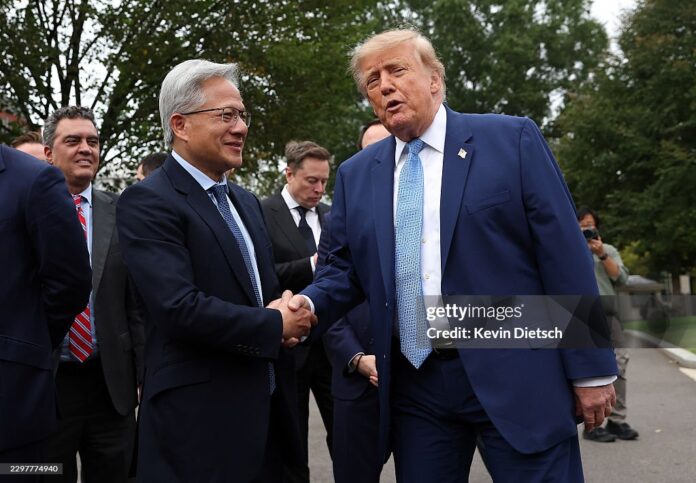

Nvidia’s decision to restore Jensen Huang as chief executive is more than a consequential corporate U-turn. When the leader of a critical AI-chip supplier leaves, returns after political intervention and triggers a 33 per cent share-price surge, the consequences reach far beyond investors. They touch military capability, technological sovereignty and the balance of power between Washington and Beijing.
On November 23, 2026, Nvidia announced that its board had unanimously reinstated Huang as president, CEO and director. He had resigned on November 12; finance chief Colette Kress became interim CEO. The board said it had received input from senior US government officials and concluded that Huang’s return posed no national-security risk. President Donald Trump had publicly urged his return and welcomed the reversal. Nvidia shares rose 33 per cent in early trading, while the Nasdaq gained about 6 per cent. The rally reflected relief, not proof that risks had disappeared.
Huang’s departure followed reports of alleged extramarital relationships, including one involving a Chinese businesswoman reportedly suspected by US authorities of intelligence links. Nvidia says an independent committee will investigate whether Huang was targeted by a foreign intelligence operation. National-security decisions must rest on evidence, not innuendo.
The institutional question is serious. A board owes independent oversight to shareholders; a president must protect national security through lawful government processes. Political preference cannot substitute for security assurance.
Nvidia
Nvidia is a consequential technology company. Its fiscal 2026 revenue reached $215.9 billion, up 65 per cent year on year; data-centre revenue was $193.5 billion. Operating income reached $130.4 billion, with a 71.1 per cent gross margin. Estimates of its AI-accelerator market share vary according to whether custom chips are included, but commonly range from roughly 70 to 85 per cent. Even the lower estimate signals concentration.
That concentration has defence consequences. AI increasingly supports intelligence analysis, cyber operations, logistics, simulation, autonomous systems and military decision-support. In 2025, the Pentagon awarded four technology firms contracts worth up to $200 million each to expand military AI workflows. Its infrastructure gives Nvidia considerable strategic importance beyond its consumer brand.
Huang’s personal influence intensifies the dependence. He co-founded Nvidia in 1993 and shaped its technical roadmap, ecosystem and government relationships. A sudden departure could disrupt an ecosystem on which governments increasingly rely. Nvidia says it has formed a board committee for national security and export-control oversight and is seeking a chief compliance officer. Credibility requires independence and willingness to challenge its founder.
Washington, Beijing and the Chip Battle
Advanced processors accelerate AI models, but the same computing capacity can strengthen military planning, surveillance, cyber capabilities and weapons research. Export controls seek to preserve American advantage by limiting China’s access to frontier computing.
Yet policy has shifted. In January 2026, the Commerce Department moved certain Nvidia H200 export applications for China from a presumption of denial to case-by-case review, subject to conditions on supply, customer security and independent testing. The House Foreign Affairs Committee later said the administration had approved applications covering 879,000 advanced Nvidia and AMD chips for Chinese firms between December 2025 and May 2026. Approvals do not prove delivery, but intensified concerns about diversion and recipients’ military links.
This is Huang’s dilemma. Restrict sales too tightly and Chinese customers have stronger incentives to develop domestic alternatives, including Huawei’s Ascend processors. Permit too much access and American-designed technology could accelerate a strategic competitor. Nvidia has commercial reasons to retain China as a market; Washington has security reasons to restrict it. Transparent licensing, end-user verification and credible penalties are more durable than presidential bargaining.
Nvidia designs chips but relies on external foundries, particularly Taiwan’s TSMC, for advanced manufacturing. Taiwan’s central role in leading-edge production makes cross-Strait tensions a direct threat to the AI economy and US defence-industrial resilience. Conflict could interrupt production and shipping, damaging cloud providers, defence contractors and infrastructure worldwide. His return cannot resolve this exposure; diversification and allied coordination are urgent.
The Price of a Founder’s Return
The 33 per cent share-price jump was a vote against uncertainty, not a verdict on governance. The market reaction exposes Nvidia’s influence over financial markets. A 33 per cent move in a mega-cap stock can lift index funds, pension portfolios and technology valuations beyond the company itself. The Nasdaq’s advance illustrates how concentrated exposure to a handful of AI leaders can transmit corporate shocks into household savings and global capital flows. This concentration is a financial-stability issue, not merely an investment story. Regulators and institutional investors should scrutinize whether market enthusiasm reflects durable earnings or the assumption that one executive can guarantee the next phase of AI growth.
For allies, access to computing power is also a question of strategic autonomy. Dependence on one American supplier can create leverage, even among allies. But the rally cannot erase unresolved scrutiny. Nvidia faces investigations concerning potential accounting issues and alleged chip smuggling; its inquiry into possible foreign intelligence targeting remains unfinished. Allegations require fair investigation.
There is a wider democratic concern. When a president presses a company to restore a particular executive and the board cites government input, other strategic firms may conclude that political access is essential to corporate survival. National-security assessments must be evidence-led, documented and insulated from relationships. That requires predictable export rules, allied manufacturing investment and stronger cyber safeguards. Nvidia must build succession depth, empower independent directors and demonstrate that compliance applies to its most powerful executive. Allies should diversify suppliers and coordinate trusted-AI standards.
Huang’s return may stabilize Nvidia in the short term. It does not resolve the contradiction at the heart of the company: Nvidia is private, but its chips are instruments of national power. America needs its innovation; China wants access; the global economy depends on its supply chain. The boardroom has become a geopolitical arena. The test is whether America can secure critical technology without political influence, founder dependence or corporate concentration becoming security weaknesses.