

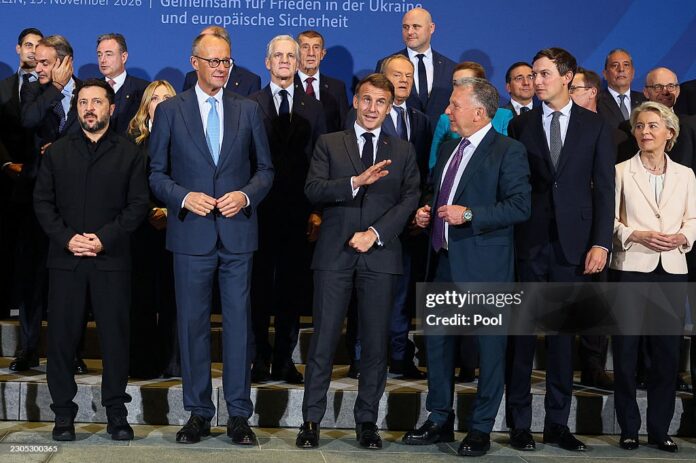

Germany’s Friedrich Merz has reopened one of NATO’s most consequential strategic debates: whether the West made a historic mistake by refusing to offer Ukraine a clear path to membership in 2008. The question is no longer merely whether Kyiv should have been admitted. It is whether Western hesitation helped create the geopolitical conditions that made Russia’s war possible, exposed the limits of NATO’s deterrence and fundamentally reshaped European security.
Bucharest’s Strategic Ambiguity and the Failure of Deterrence
The April 2008 Bucharest summit exposed a fundamental contradiction in NATO’s approach to Russia and the security of Eastern Europe. President George W. Bush advocated a Membership Action Plan (MAP) for Ukraine and Georgia, a formal mechanism designed to prepare aspiring countries for eventual accession. Germany and France, led by Angela Merkel and Nicolas Sarkozy, opposed the proposal, fearing that accelerating NATO enlargement would provoke Moscow and destabilise European security. The compromise was strategically damaging: NATO declared that Ukraine and Georgia would eventually become members but offered neither a timetable nor an immediate pathway. That ambiguity arguably created a dangerous gap between political aspiration and credible deterrence.
Merz’s retrospective criticism identifies this contradiction as a central weakness of Western strategy. Ukraine received a promise without the protection that membership would have provided. Russia, meanwhile, confronted neither a definitive rejection of Ukraine’s Western ambitions nor an immediate military deterrent capable of preventing coercion. The Kremlin could interpret NATO’s declaration as a long-term strategic threat while exploiting Kyiv’s immediate vulnerability. The subsequent Russian invasion of Georgia in August 2008 demonstrated that Moscow was prepared to use military force against neighbouring states pursuing closer Western integration.
The Deterrence Paradox
Merz’s assertion that NATO membership could have prevented Russia’s full-scale invasion is strategically plausible, but it remains a counterfactual rather than an established fact. NATO’s Article 5 collective-defence commitment fundamentally alters an aggressor’s calculations by potentially transforming a bilateral conflict into a confrontation involving 32 countries. An attack on Ukraine, had it been a member, could have triggered military intervention by the United States, Britain, France, Germany and other allies, dramatically raising the risks and potential costs for Moscow.
Yet the deterrence argument has a complication. Russia might have invaded Ukraine before accession, escalated military pressure during the membership process or pursued destabilization through political interference, cyberattacks and proxy forces. Moscow’s annexation of Crimea in 2014 and intervention in eastern Ukraine demonstrated its willingness to exploit vulnerabilities without necessarily initiating a direct confrontation with NATO. The question is whether membership would have deterred aggression or whether the prospect of accession could have precipitated an earlier confrontation.
Merkel’s objections therefore cannot be dismissed as simply misguided. She argued that Ukraine’s accession prospects were politically and militarily complicated, and that Moscow might have responded violently before NATO could provide protection. The strategic failure, however, arguably lay in promising eventual membership while failing to develop a credible interim deterrence architecture capable of protecting Ukraine from coercion.
Europe’s Security Architecture, Russia and the Geopolitical Consequences
Merz’s remarks carry implications beyond historical accountability. They challenge the assumptions underpinning Europe’s post-Cold War security architecture, particularly the belief that economic integration, diplomatic engagement and restraint in NATO enlargement could contain Russian revisionism. Russia’s invasions of Georgia in 2008 and Ukraine in 2014 and 2022 progressively undermined that assumption, demonstrating that economic interdependence alone could not guarantee territorial security.
The consequences have been profound. NATO’s expansion to 32 members, following Finland’s accession in 2023 and Sweden’s in 2024, illustrates how Russia’s aggression has accelerated the very strategic realignment Moscow sought to resist. European governments have also increased defence spending, strengthened eastern-flank deployments and reconsidered the continent’s dependence on American military protection. NATO’s longstanding benchmark of spending at least 2% of GDP on defence has become increasingly central to political debates over military readiness and burden-sharing.
Germany’s transformation is particularly consequential. Merz’s criticism reinforces the strategic shift away from the assumptions of Merkel-era Ostpolitik, which prioritized engagement and economic ties with Russia. Berlin’s recognition that deterrence requires credible military capabilities, sustained defence investment and dependable security guarantees reflects a broader European reassessment. The geopolitical lesson is stark: strategic restraint without credible protection can leave vulnerable states exposed while encouraging adversaries to test the limits of Western commitments.
NATO Membership, Peace Negotiations and the Credibility Trap
Merz’s position also complicates negotiations over ending the war. Russian President Vladimir Putin has consistently opposed Ukraine’s NATO ambitions, while Kyiv regards Western security guarantees as indispensable to preventing another invasion. NATO membership would offer the strongest institutional protection, but unanimous agreement among all allies remains necessary. Merz’s endorsement of reconsidering the 2008 decision does not mean Germany or NATO has committed to admitting Ukraine immediately.
The German chancellor has also supported security guarantees resembling Article 5, potentially approaching the protection offered by NATO membership. Such guarantees could strengthen Ukraine’s negotiating position, but their credibility would depend on military commitments, enforcement mechanisms, weapons supplies and the willingness of guarantors to respond to renewed Russian aggression. Vague assurances could reproduce the weaknesses of Bucharest.
The strategic challenge is therefore not simply correcting a historical decision. It is preventing another security arrangement that promises protection without delivering sufficient deterrence. If Ukraine remains outside NATO, European governments must construct guarantees sufficiently credible to discourage Moscow from testing them. If membership eventually becomes possible, NATO must confront the military, political and escalation risks openly rather than conceal them behind diplomatic ambiguity.
Merz’s admission is significant because it challenges a policy that helped define European security for nearly two decades. But acknowledging a mistake is not the same as correcting it. Europe’s credibility will ultimately depend on whether it can transform the lessons of Bucharest into a security architecture capable of preventing another war.